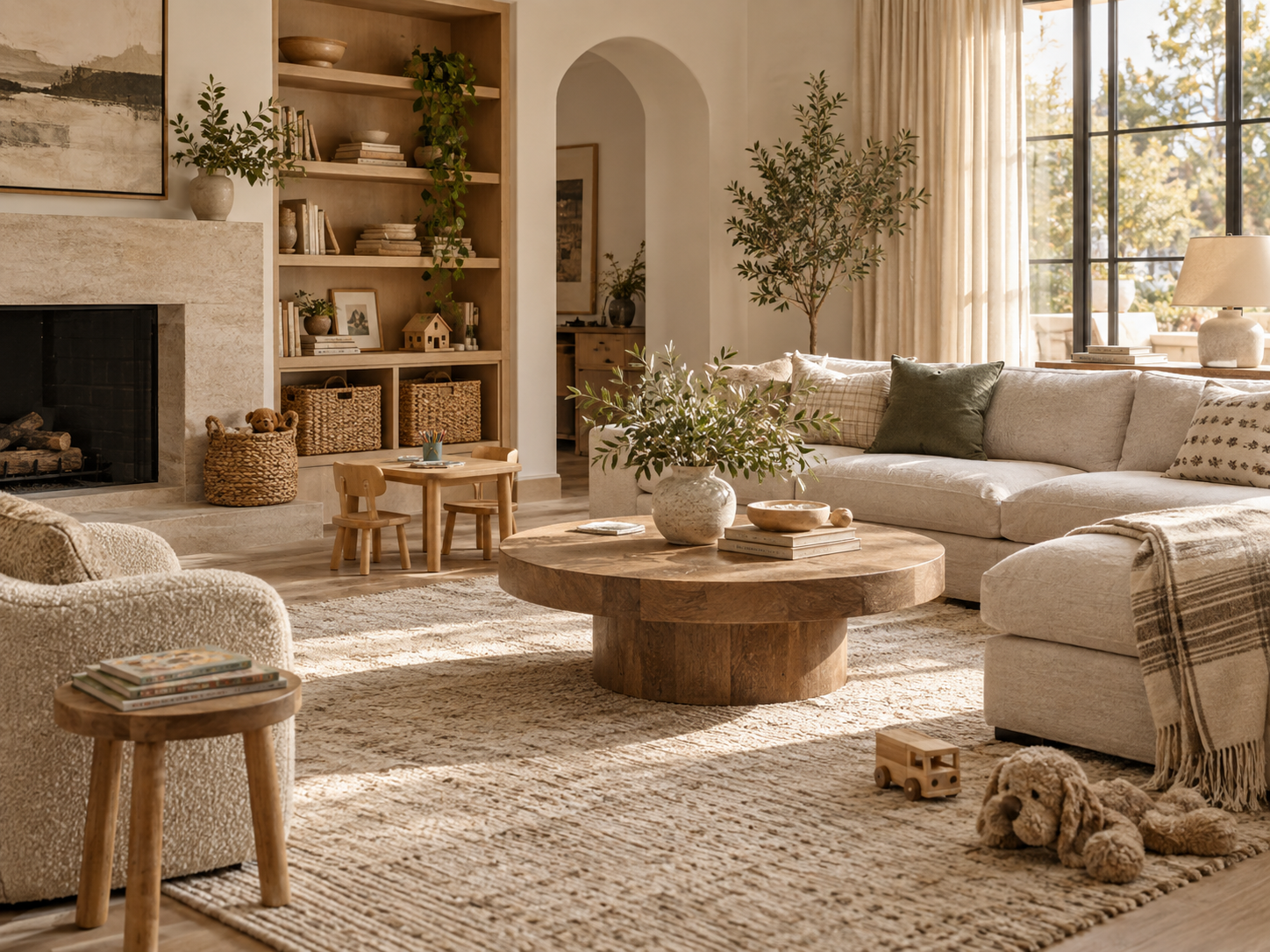
If you love beautiful interiors and you also have kids, you probably know the tension.
You want the house to feel calm, thoughtful, and put together.
They want to build a fort in the living room, leave books on the floor, move a stool into the kitchen, and somehow transform one box of crayons into a full-room installation.
The good news is that a kid-friendly home does not have to mean giving up on the way you want your home to look.
And it definitely does not mean making every room feel like a playroom.
The goal is to create a home that works for everyone who lives there.
That means spaces kids can actually use, storage they can reach, routines that feel easier, and rooms that still feel beautiful and intentional for the adults too.
A few thoughtful design choices can make a surprisingly big difference.
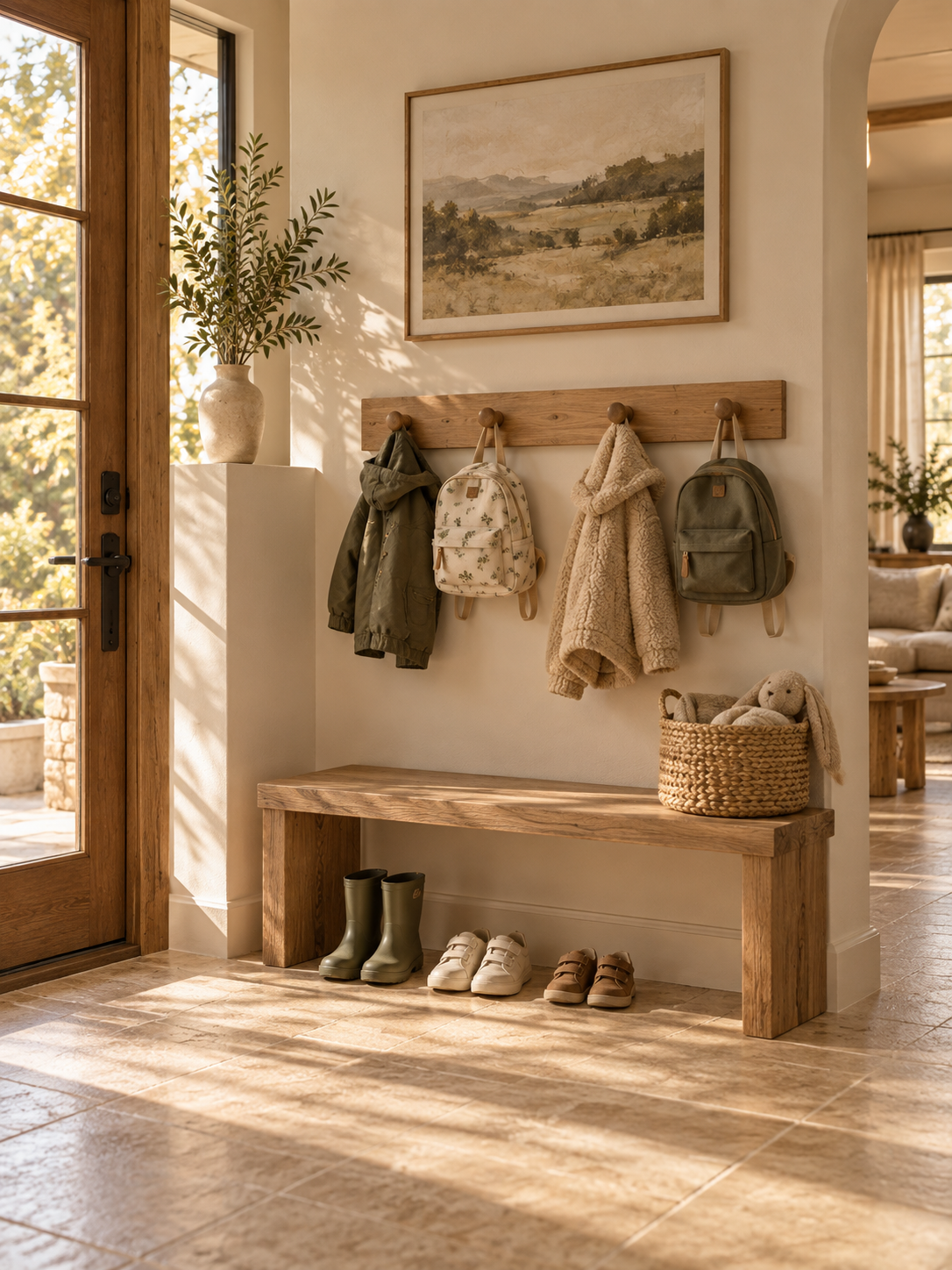
1. Design for Independence, Not Just Storage
One of the easiest ways to make a home work better for kids is to think about what they can actually reach and use on their own.
If every hook, drawer, basket, and shelf is designed only for adult height, everyday routines depend on an adult every single time.
Make the house easier to use
Try:
- low hooks for jackets or backpacks
- reachable book storage
- a small basket for shoes
- step stools where useful
- low drawers for everyday items
- simple bins children can open and close easily
The point is not to make the whole house child-sized.
It is to make a few everyday moments easier.
A home that supports a little independence often feels smoother for everyone.
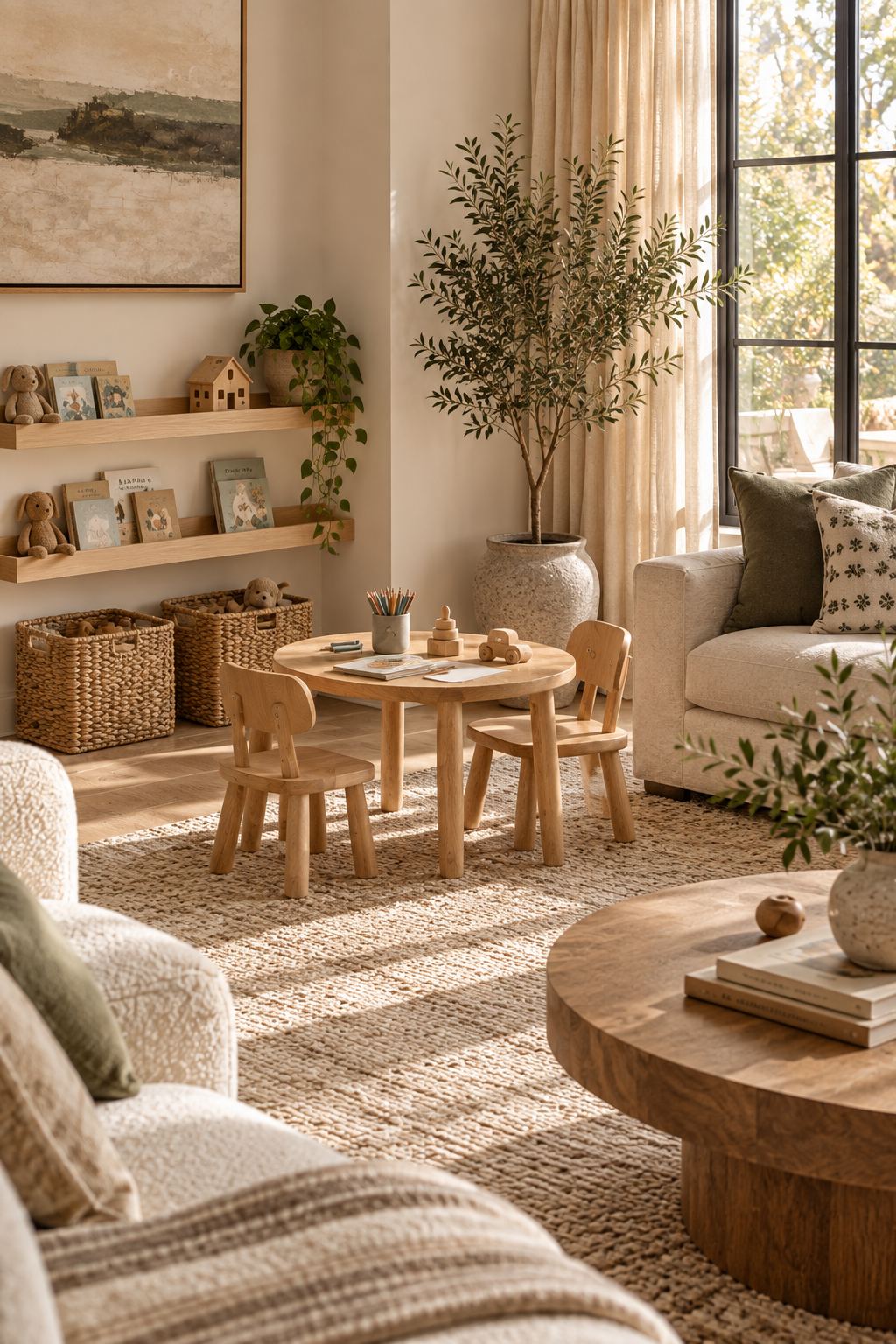
2. Create One Clear Place for Play
Not every family has a playroom.
And honestly, not every family needs one.
A play zone can be one corner of the living room, part of a bedroom, a section of a family room, or even a small nook under a window.
What matters is giving play a place to land.
How to make it feel intentional
Use a rug, shelving unit, small table, or low storage piece to visually define the area.
Keep the scale appropriate for the room.
You do not need to build a miniature preschool inside your house.
The goal is simply to make it obvious where play belongs.
That alone can help the rest of the room feel calmer.
3. Let Kids Have Visible Things Without Letting Everything Be Visible
A beautiful family home does not need to hide every sign that children live there.
Books, toys, drawings, and little objects can add personality and warmth.
The trick is deciding what deserves to stay visible and what does not.
Think in layers
Keep the most-used items within reach.
Display a few books with beautiful covers.
Leave out one or two favorite toys.
Show a small piece of artwork.
Then use drawers, cabinets, or baskets for the rest.
Not everything needs to be on display at once.
That balance makes a room feel lived-in without feeling visually noisy.
4. Make Their Things Feel Like Part of the Room
Children’s furniture and storage do not have to feel completely separate from the rest of the home.
A small table can still have a beautiful shape.
A toy basket can still be woven, canvas, or wood.
A book ledge can still work with the room.
A quilt or cushion can still fit the color palette.
The goal
Do not try to erase kid things.
Just choose a few pieces that visually belong in the space.
That way, the room feels shared rather than divided into “adult decor” and “kid stuff.”
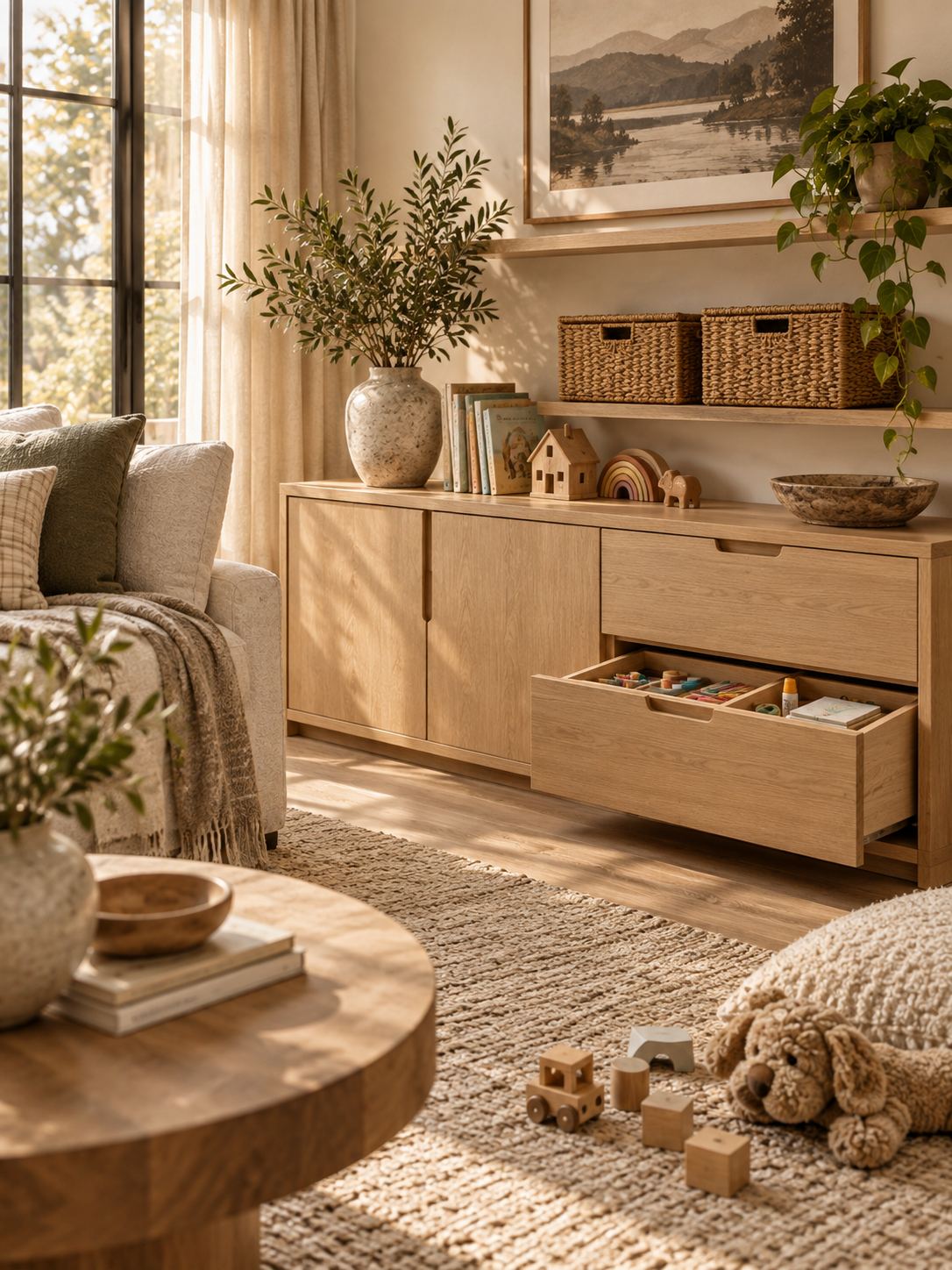
5. Use Closed Storage for Visual Calm
Open storage is great for accessibility.
Closed storage is what helps the room breathe.
A low cabinet with doors, drawers under a bench, or baskets inside a console can make a huge difference.
What works well behind closed doors
- extra toys
- art supplies
- puzzles
- small-piece games
- dress-up items
- electronics
- backup craft materials
The idea is simple:
Keep everyday favorites easy to reach.
Let the visually busy things disappear when you are done with them.
6. Rotate Instead of Displaying Everything
Sometimes the easiest way to make a room feel calmer is to show less.
That does not mean getting rid of everything.
It just means not putting every toy, book, puzzle, and activity out at the same time.
Try a simple rotation
Keep a smaller selection accessible.
Store the rest somewhere else.
Then rotate items every few weeks.
You do not need a strict schedule.
Even swapping one or two baskets can make the space feel fresh without adding anything new.
7. Create Small “Routine Zones”
One thing that makes family life easier is giving recurring routines a place.
That can be especially helpful in transition areas.
Think about places like
- the entry
- the bathroom
- the bedtime zone
- the art table
- the kitchen
- the getting-ready area
A hook near the door.
A step stool by the sink.
A basket for bedtime books.
A drawer with art supplies.
A small tray for hairbrushes or accessories.
Tiny zones can make everyday routines feel more intuitive.
8. Keep the Entry Working Hard
The entry is one of the places where family clutter builds fastest.
Shoes.
Backpacks.
Jackets.
Lunch bags.
Sports things.
Random objects that somehow came home from school.
Make it easier
Give each category a place.
Use hooks, a bench, a basket, a drawer, or a low cabinet.
You do not need a perfect mudroom.
Even one wall with hooks and one basket can make the space function better.
The key is designing around what actually lands there every day.
9. Choose Furniture That Can Change With Them
Kids change quickly.
Furniture that can adapt tends to stay useful longer.
A bench can work in an entry now and a bedroom later.
A low shelf can hold toys now and books later.
A storage ottoman can hide playthings today and blankets in a few years.
A console with drawers can shift from toy storage to school supplies.
Think long-term
Whenever possible, choose pieces that can change purpose.
That makes the room easier to evolve without constantly starting over.
10. Keep the House Visually Calm Without Making It Boring
A calm family home does not need to be colorless.
It just helps to be intentional about where color lives.
If the toys are bright, keep the storage quieter.
If the rug has pattern, maybe the walls stay simpler.
If the room has lots of books and art, let the larger furniture pieces feel more neutral.
Use contrast on purpose
The goal is not to eliminate color.
It is to avoid having every surface compete for attention at the same time.
That usually makes the space feel more peaceful without stripping away personality.
11. Let Kids Have Their Own Display Space
One of the nicest ways to include kids in the home visually is to give them a small place to show what matters to them.
A pinboard.
A picture ledge.
A magnetic strip.
A framed drawing.
A small shelf.
Keep it contained
Instead of covering every wall or surface, give their creations a clear home.
That makes the display feel intentional rather than scattered.
It also lets the rest of the room stay visually quieter.
12. Use Materials That Are Forgiving, Not Precious
Durability still matters in a family home.
But the goal is not to turn the entire house into a wipe-clean zone.
Use forgiving materials where life happens most.
Washable fabrics.
Tightly woven upholstery.
Rugs that can handle foot traffic.
Wood finishes that age well.
Surfaces that can be wiped easily.
A good rule
Use delicate materials where they can realistically stay delicate.
Use practical ones where snacks, art, play, and everyday life actually happen.
That balance usually works better than trying to make every room either precious or indestructible.
13. Make Safety Part of the Design
Safety features do not need to feel like an afterthought.
Where possible, integrate them into the room visually.
Use discreet cord management.
Keep pathways clear.
Anchor furniture carefully.
Think about furniture placement in high-traffic areas.
Choose barriers or gates that work with the surrounding materials when you can.
The goal
Safety comes first.
But thoughtful placement and styling can help the room still feel cohesive.
14. Keep the House Easy to Reset
This is where good family design really proves itself.
A home with kids does not need to stay perfect all day.
It needs to be able to recover.
That means:
- storage that is easy to use
- baskets that are not too heavy
- surfaces that are easy to clear
- systems that do not require twenty steps
- furniture that can handle everyday life
A room that can go from “we actually live here” to “this feels calm again” in ten or fifteen minutes is doing its job.
The goal is not perfection.
It is resetability.
15. Do Not Design the House for a Photograph
A room can look incredible in a photo and still be frustrating to live in.
If the toy storage is too high, it does not really help.
If a basket looks beautiful but is impossible to move, it may not be practical.
If the furniture layout leaves no room to play, the room may look elegant but still fail the people using it.
Good design should support the life happening inside the house.
Not work against it.
16. Leave Room for the House to Change
A home with kids is always changing.
What works at one stage may not work a year later.
That is why flexible design matters so much.
Choose storage that can change purpose.
Use furniture that can move.
Avoid making every solution overly permanent.
Let the house evolve as routines change.
The best family homes are not frozen in one stage.
They adapt.
A Kid-Friendly Home Can Still Feel Like Your Home
A kid-friendly home does not need to look child-free.
And it does not need to look like a playroom either.
It can be warm, beautiful, functional, and clearly lived in.
There can be toys.
There can be books.
There can be little shoes by the door.
There can be drawings on the wall.
There can also be good lighting, beautiful materials, calm corners, and rooms that still feel like you.
That is really the goal.
Not a perfect house.
A home that makes room for family life without asking you to give up everything you love about design.
Match the system to the current stage
| Stage or routine | Design priority | Review often |
|---|---|---|
| Early mobility | Clear paths, secure storage, adult-controlled hazards | Reach and climbing ability |
| Independent routines | Reachable hooks, books, clothing, and cleanup targets | Whether the system is genuinely usable |
| School years | Paper, backpack, activity, and homework zones | Changing schedules and equipment |
| Shared-age room | Separate access levels and safe storage for small pieces | What younger children can reach |
A system that worked six months ago may fail because a child’s reach, interests, school routine, or mobility changed. Review the room instead of assuming the child is failing the system.
Use a safety-first review separate from styling
Decorating advice is not a complete childproofing assessment. The U.S. Consumer Product Safety Commission advises securing furniture and televisions to prevent tip-over and identifies cordless window coverings as the safest option where young children are present. Follow current manufacturer instructions and safety guidance for the child’s age and the products in the home.
- CPSC Anchor It: furniture and television tip-over prevention
- CPSC guidance on window-covering cords
- CPSC childproofing guidance
Check product recalls and local guidance when relevant. Do not rely on a decorative basket, furniture arrangement, or social-media “hack” as a safety device.
Design cleanup around visible limits
Choose containers children can safely handle and avoid filling them to the point where resetting requires careful packing. A picture or simple word label can show what belongs where. Put adult-controlled supplies, small parts, and unsuitable materials in secured storage.
Use a short reset sequence: return books, collect one toy category, clear the main path, and prepare the next routine. The room does not need to be restored to a photograph.
A family-room test before buying storage
- Observe one full play-and-cleanup cycle.
- Identify which items are used and which are only emptied.
- Measure the true volume of each active category.
- Place a temporary box or basket at the natural cleanup point.
- Test whether children and adults can use it for a week.
- Buy permanent storage only after the location and capacity work.
For arrival routines, use the adaptable entryway system. For a broader weekly reset, see the Sunday reset routine.
How this guide was developed: The design framework considers independence, reach, routine zones, visual calm, flexible storage, and reset time. Safety is treated as a separate priority governed by current official guidance and product instructions, not as an aesthetic feature. Reviewed October 13, 2026.