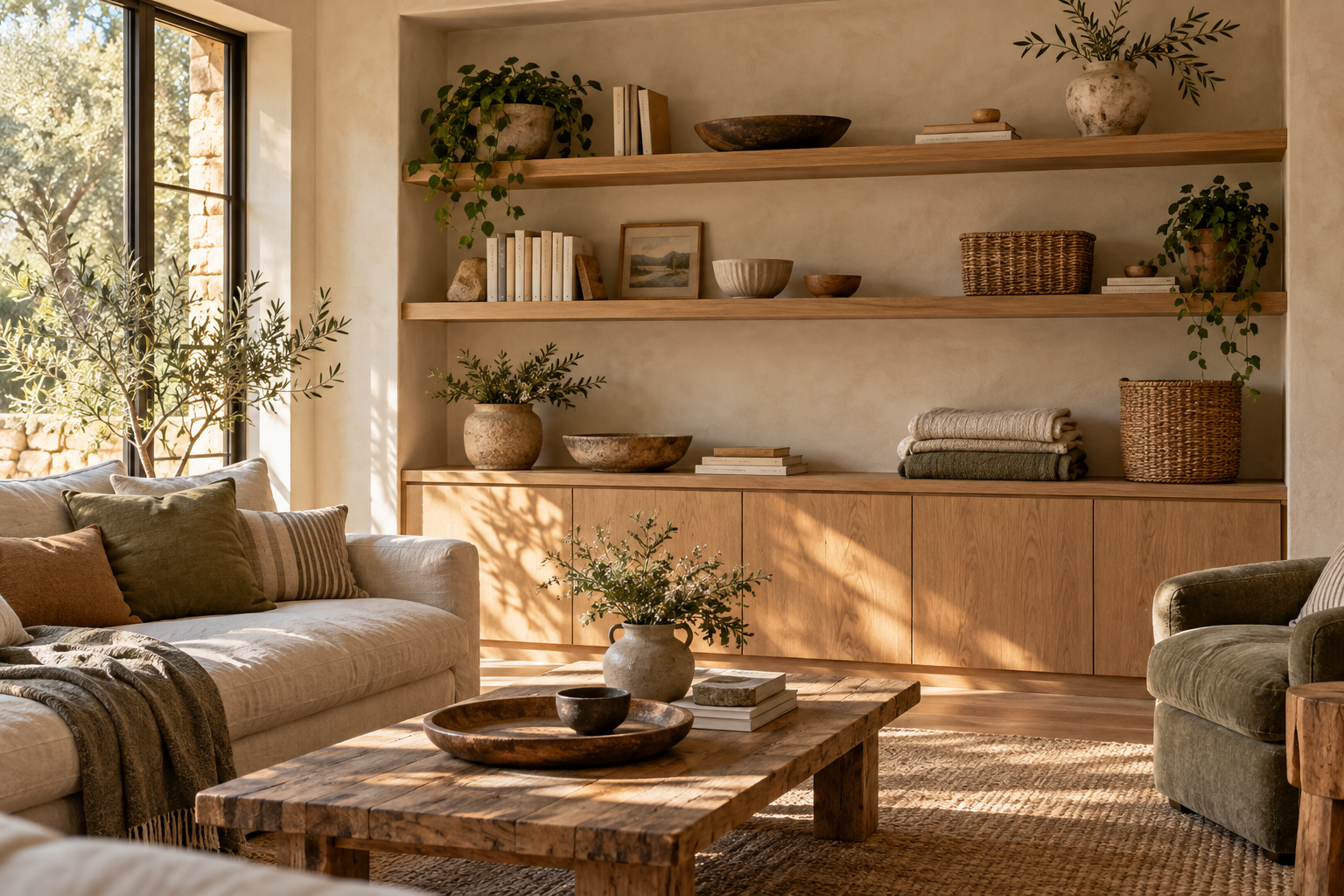
Open storage has a funny reputation.
In perfectly styled photos, it looks effortless: beautiful baskets, neatly folded blankets, ceramic bowls, books, trays, and everyday objects that somehow seem to belong exactly where they are.
In real life, open storage can go one of two ways.
It can make a home feel practical, accessible, and beautifully lived-in.
Or it can become a very public record of everything you own.
The good news is that you do not need to be naturally organized to make open storage work.
In fact, it can be one of the best tools for people who prefer easy, visible systems — as long as the storage is designed around what you actually use and not around how a Pinterest shelf looks for five minutes.
The secret is not perfect organization.
It is knowing what deserves to stay visible, what needs a little visual camouflage, and what should probably live behind a door.
1. Start With the Things You Actually Use
Open storage works best when it holds things you reach for regularly.
Think:
- everyday dishes
- books
- blankets
- towels
- baskets
- pet supplies
- shoes near the entry
- frequently used pantry items
- trays and serving pieces
The more often you use something, the more sense it makes to keep it easy to access.
Open storage becomes frustrating when it is filled with objects that look nice but are constantly in the way.
A simple rule
If you use it often and it looks reasonably good, it is probably a good candidate to stay visible.
If you rarely use it and it creates visual noise, it may be better behind a door.
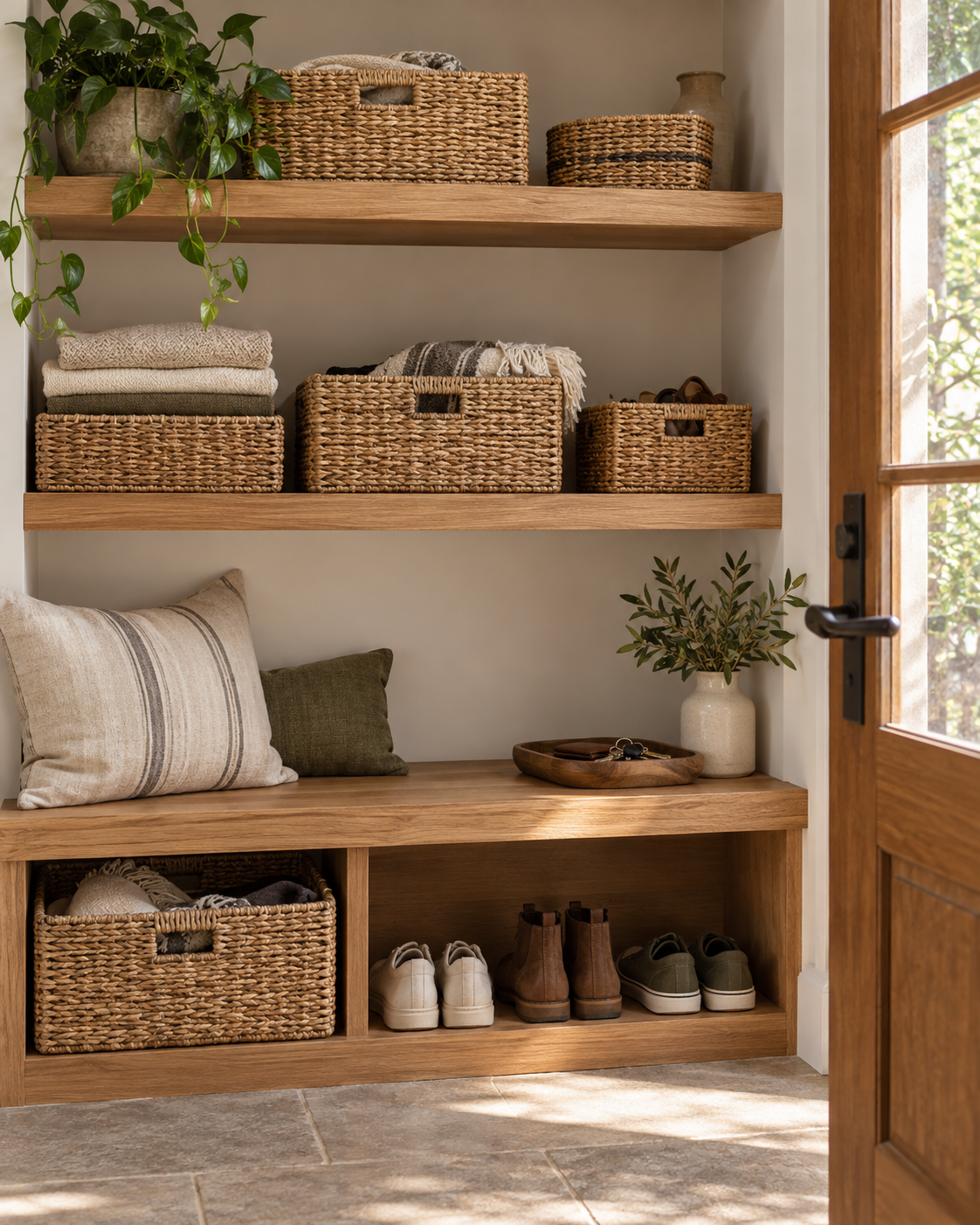
2. Use Baskets as Visual Camouflage
This may be the true magic trick.
You do not need every object inside open storage to be beautiful.
You just need a few containers that are.
A woven basket can hide:
- chargers
- dog accessories
- small toys
- cables
- miscellaneous entryway things
- cleaning cloths
- extra toiletries
Suddenly, five visually unrelated things become one calm object.
Why this works
The basket is not just storage.
It is visual editing.
You are not removing the clutter entirely.
You are grouping it so the eye reads one shape instead of ten.
3. Repeat Materials or Colors
Open storage looks calmer when there is some repetition.
That does not mean everything has to match.
It just means a few materials or colors should appear more than once.
For example:
- three baskets in similar tones
- two ceramic pieces in the same family
- repeated wood
- clear glass
- warm brass
- black metal
- linen
Repetition gives the eye something familiar to follow.
That makes the storage feel intentional even when the objects themselves are different.
4. Do Not Fill Every Inch
This is one of the biggest differences between open storage that looks good and open storage that feels chaotic.
Leave some empty space.
You do not need to maximize every shelf.
A shelf with six things on it often looks better than a shelf with fourteen.
Why empty space matters
It helps individual objects read more clearly.
It keeps the whole wall from feeling heavy.
And it gives you a little flexibility when new things inevitably appear.
Open storage needs breathing room.
5. Keep the Shapes Simple
If every visible object has a different shape, color, label, and texture, the result can feel busy very quickly.
That is especially true in kitchens and bathrooms.
Try simplifying the silhouettes
Group similar items together.
Use trays.
Stack books.
Fold textiles consistently.
Use jars or containers for small loose items.
The goal is not to make everything identical.
It is to reduce visual fragmentation.
6. Make It Easy to Put Things Back
This is where open storage becomes incredibly useful for people who are not naturally organized.
You should be able to put something away in one motion.
Not:
open cabinet
move three things
lift lid
find correct compartment
rearrange everything
close lid
put container back
That system is not going to survive a busy Tuesday.
Better open storage is almost frictionless
Put the blanket in the basket.
Place the shoes on the shelf.
Drop the mail in the tray.
Stack the plates.
Put the book back.
Done.
The fewer steps involved, the more likely the system is to actually work.
7. Use Open Storage Where Visibility Helps
There are rooms where seeing what you have is genuinely useful.
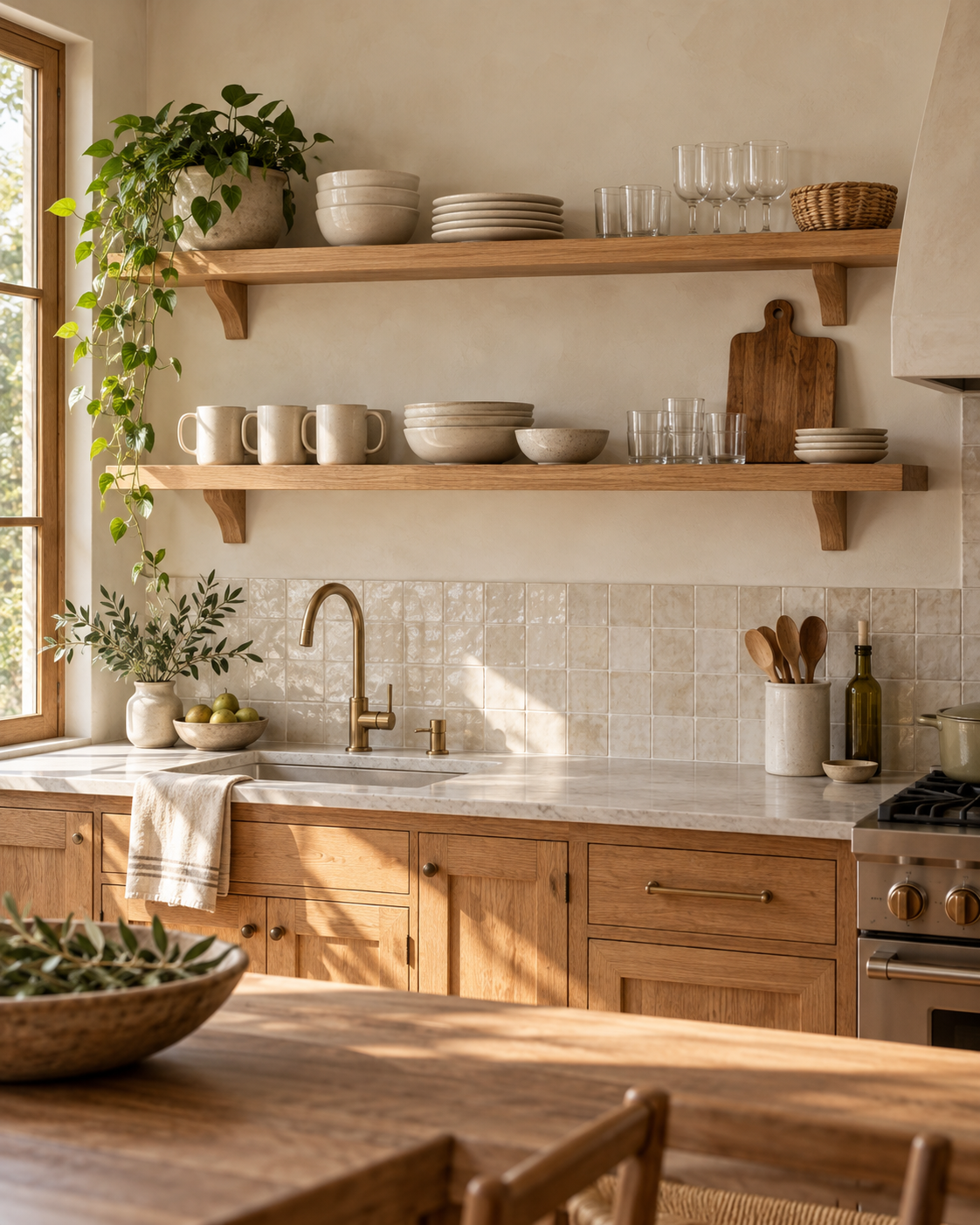
Kitchen
Open shelves can work beautifully for everyday dishes, glasses, bowls, coffee supplies, and serving pieces.
But if you rarely use something, it may just collect dust.
Bathroom
Rolled towels, baskets, simple toiletries, and frequently used products can work well.
Backups and visually busy packaging are usually better hidden.
Entryway
Shoes, bags, keys, baskets, and jackets can all benefit from visible, accessible storage.
Living room
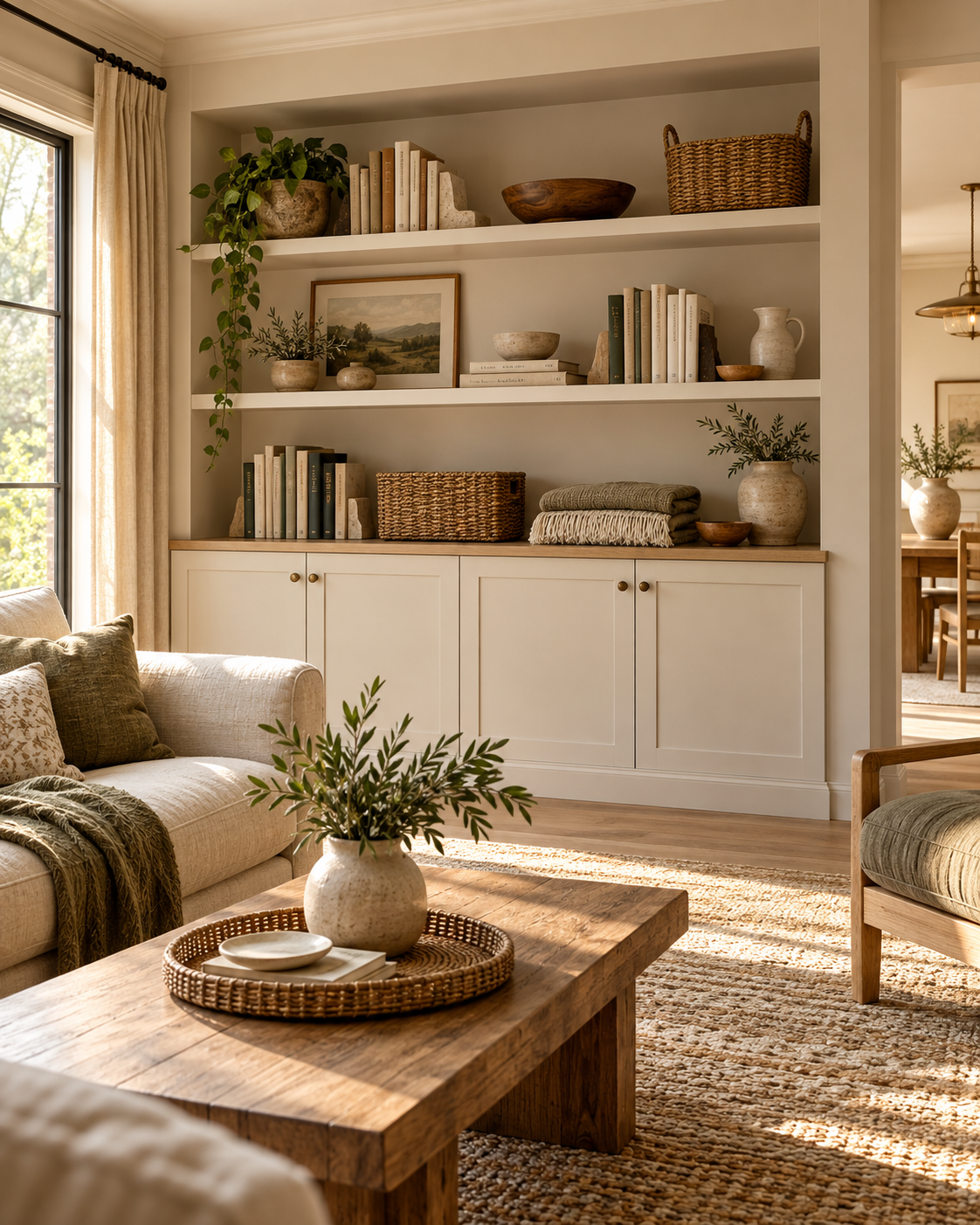
Books, blankets, beautiful boxes, baskets, and a few decorative objects work well.
Laundry or utility space
Open shelving can be extremely functional here, especially when products are grouped into clear categories.
8. Know What Should Stay Hidden
Open storage is not a moral obligation.
Some things are simply easier to live with when you cannot see them.
For example:
- paperwork
- cables
- medicine
- cleaning backups
- miscellaneous tools
- cluttered food packaging
- extra toiletries
- small electronics
- random objects with no visual relationship to each other
This is where closed storage earns its place.
The best homes usually use both
Open storage for easy access and beautiful everyday objects.
Closed storage for the things that do not need to become part of the visual landscape.
9. Avoid Turning Every Shelf Into Decor
One of the easiest traps is styling open storage so carefully that it stops being useful.
If every shelf has a vase, two books, a candle, a bowl, and a decorative object, where does real life go?
Let storage still be storage
A shelf can hold actual plates.
A basket can contain actual clutter.
A bench can hold shoes.
A console can have a tray for keys.
Not every surface needs to become a still life.
10. Watch the Packaging
Packaging is one of the fastest ways open storage starts to feel messy.
Bright labels.
Different bottle shapes.
Boxes.
Plastic bags.
Random colors.
You do not need to decant everything in your house.
But in highly visible storage, a little editing can help.
A practical approach
Only decant things you use frequently and that are genuinely easier to access that way.
For everything else, use a basket, bin, or closed cabinet.
Do not create more work just to make the shelf prettier.
11. Style in Small Groups
If you want open storage to look polished, think in small clusters rather than single scattered objects.
For example:
- stack of books + bowl
- basket + folded blanket
- tray + candle + vase
- two ceramic bowls + wooden board
Small groups feel more intentional than lots of unrelated items spaced evenly across a shelf.
But do not overdo it
You still want the storage to function.
A beautiful arrangement that has to be dismantled every time you need something is probably not worth it.
12. Let Some Things Look Lived-In
Open storage should not look frozen.
A slightly imperfect stack of books.
A folded throw.
Shoes that are actually worn.
A mug beside the coffee setup.
A basket that is not perfectly symmetrical.
These things make a space feel real.
The goal is not to create a showroom.
It is to create a home that looks good while being used.
When Open Storage Becomes Too Much
Open storage is not always the answer.
It may be working against you if:
- every shelf feels crowded
- you constantly need to dust everything
- packaging dominates the view
- you feel like you are always restyling it
- the room never feels visually calm
- you do not actually use the things on display
At that point, closed storage may make more sense.
And that is completely fine.
Open Storage vs Closed Storage: The Real Difference
Open storage is better for:
- easy access
- frequently used items
- visually attractive objects
- spaces where visibility helps
- quick reset systems
Closed storage is better for:
- visual calm
- paperwork
- small clutter
- backups
- random categories
- things you do not need to see every day
The best solution is usually not choosing one.
It is knowing where each one works better.
The Real Magic of Open Storage
Open storage is not about being perfectly organized.
It is about making your everyday things easier to live with.
For people who are naturally tidy, it can look beautiful.
For people who are slightly chaotic but visually strategic?
It can be brilliant.
A basket here.
A tray there.
A few repeated materials.
Some empty space.
And suddenly the mess is not gone.
It just looks like it has a plan.
Choose storage by access frequency and exposure
| Question | If yes | If no |
|---|---|---|
| Is the item used at least weekly? | Open storage may reduce friction | Consider closed or remote storage |
| Can it tolerate dust, light, humidity, or kitchen residue? | Visible storage may be practical | Protect it behind a door or in a suitable container |
| Can it return in one motion? | The system may survive busy days | Simplify the container or location |
| Is it safe and appropriate to leave accessible? | Choose a clear category and limit | Use secured storage |
Do not let decanting remove essential information
Keep original labels, instructions, dates, allergen information, batch details, and safety warnings whenever they matter. Never transfer medication, cleaning products, pest products, or hazardous substances into decorative or food-like containers.
For dry food, use containers suitable for food contact and preserve identifying information needed by the household. Decant only when it improves use—not merely to make every package look identical.
Plan for dust, grease, and moisture
Open kitchen shelves near cooking collect more residue than shelves farther away. Bathroom storage must tolerate humidity and should not expose items that require dry or hygienic conditions. Books and textiles near strong sunlight can fade.
Before installing open storage, decide how it will be cleaned and whether the household is willing to maintain the objects on it. A beautiful shelf that creates an unwanted weekly chore is not a low-friction system.
Verify the physical system
Follow manufacturer instructions for shelf installation, wall type, anchors, and weight limits. Distribute heavy items appropriately and avoid placing unstable or hazardous objects where children or pets can reach or pull them down.
Baskets also have limits: confirm handles, base strength, and whether the loaded container can be lifted safely from its position.
A seven-day open-storage test
- Use temporary boxes or existing baskets in the proposed locations.
- Label categories in plain language.
- Track what lands outside the containers.
- Notice which items collect dust or require extra steps.
- Reduce each category to the capacity that fits comfortably.
- Purchase permanent storage only after the location works.
Compare this approach with the guide to storage solutions that genuinely solve a problem and use the entryway system for arrival-zone storage.
How this guide was developed: The framework evaluates visibility, frequency, exposure, safety, cleaning effort, and reset friction. Open storage is recommended only when access benefits outweigh maintenance and visual cost. Reviewed October 13, 2026.