If you love both pets and decorating, you already know the problem.
The fur. The muddy paws. The toys that somehow end up in every room. The leash you can never find when you are already late. The blanket that belongs to the dog but somehow migrates across the entire house.
And, of course, not everyone wants to redesign their whole home around a pet — and that is completely fine.
The good news is that you do not have to.
A few small choices can make a surprisingly big difference in the way your home works day to day. You can make things easier to clean, easier to reset, and easier to live with without sacrificing the way you want your home to look.
You do not need to use every idea on this list.
Even a few of them can make everyday life at home feel noticeably easier.
Here are the pet-friendly home ideas we think actually make a difference.
1. Choose Materials That Can Handle Real Life
When you live with pets, durability matters more than perfection.
That does not mean choosing ugly furniture. It means paying attention to what a material will look like after months or years of actual use.
Performance fabrics, tightly woven textiles, washable covers, leather that develops character, and rugs with a little visual texture tend to be much more forgiving than delicate materials.
What to look for
Choose fabrics that are easy to vacuum, wipe, or wash. Avoid very loose weaves if claws are an issue, and think twice before choosing ultra-light upholstery if muddy paws are part of your daily reality.
A material that ages well will usually make the room feel better for longer than something beautiful but fragile.
2. Stop Fighting the Fur
Pet hair becomes much more noticeable when there is a strong contrast between the fur and the furniture.
A black sofa with a white dog can quickly turn into a full-time cleaning project.
What to do instead
When possible, choose upholstery, rugs, and throws in mid-tones, textured fabrics, or colors that do not highlight every single hair.
This does not mean letting fur accumulate forever or accepting a dirty house.
Not at all.
It simply means giving yourself a little breathing room between cleanups.
Your home can still feel clean and cared for without making every single stray hair look like an emergency.
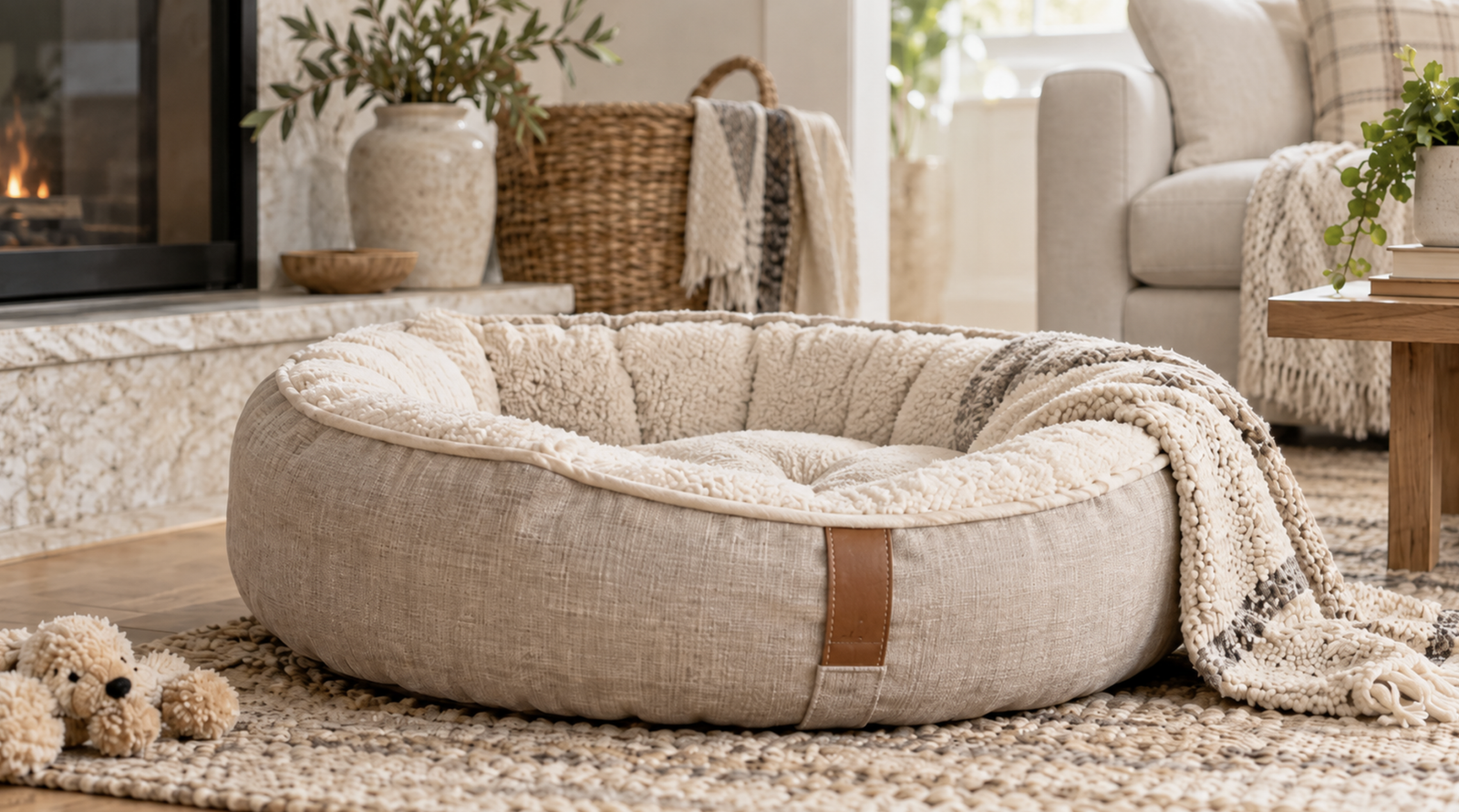
3. Make Pet Beds Part of the Room
Pet beds are often treated like something we have to hide.
But if your dog or cat uses one every day, it is effectively a piece of furniture.
So treat it like one.
How to make it work
Look for simple shapes, neutral or earthy fabrics, and colors that relate to the rest of the room.
Place the bed where your pet naturally wants to be — not where it looks best in a photo.
A beautiful pet bed in the right place will always look better than one constantly being dragged across the room.
4. Give Toys Somewhere to Go
Pet toys spread surprisingly fast.
One basket can solve a lot.
How to get the look
Use a low woven basket, canvas bin, wooden box, or another container that fits the style of the room.
Keep it somewhere your pet can access easily.
The goal is not to eliminate toys from sight completely. It is to give them a home so the room can return to calm quickly.
5. Give Their Everyday Things a Drawer
Toys are one thing.
The rest of the pet stuff is another.
Leashes, brushes, grooming tools, clothes, medications, spare blankets, poop bags, harnesses and all the small things you need regularly can create clutter surprisingly quickly.
Make one place for all of it
Dedicate a drawer, basket, or cabinet to your pet’s everyday supplies.
It does not need to be elaborate.
The important part is knowing exactly where everything lives.
Having one designated spot saves you from searching through three different rooms every time you need the brush or leash.
6. Make Feeding Areas Feel Intentional
Food and water bowls are necessary, but they often end up looking like an afterthought.
A small amount of planning can make that corner feel much more considered.
How to make it work
Use a simple tray or mat underneath the bowls, choose bowls with a clean shape, and place them somewhere that is easy to clean.
If you have space, a small feeding station integrated into cabinetry can look beautiful.
But even without custom millwork, consistency in material and placement makes a big difference.
7. Use Rugs Strategically
Rugs are one of the best tools in a pet-friendly home — if you choose the right ones.
They add warmth, soften noise, protect floors, and can make a room feel much more finished.
They can also collect fur, stains, and smells.
What works best
Look for low-pile rugs, washable options, indoor-outdoor materials, or patterns that are forgiving.
Avoid anything so precious that you will panic every time your dog walks across it.
A rug should make the room easier to live in, not harder.
8. Keep a Good Cordless Vacuum Within Reach
This might be one of the least glamorous tips on the list, but it can make one of the biggest differences.
Investing in a good cordless vacuum that is easy to grab and ready to use can make everyday pet mess feel far more manageable.
And no — this does not mean spending your entire day cleaning.
Quite the opposite.
The point is to have a tool that can rescue you quickly when you actually need it.
Maybe someone is coming over and you suddenly notice a mysterious collection of fur under the coffee table.
Maybe the dog tracked something inside.
Maybe the sofa just needs a two-minute pass.
When the vacuum is lightweight, cordless, and easy to access, those small cleanups stop feeling like a whole production.
9. Create a Cleaning Station Near the Entrance
If your pet spends time outside, one of the best things you can do is stop dirt before it travels through the house.
Keep nearby
A towel, paw wipes, leash, brush, waste bags, and anything else you regularly need.
A small basket, drawer, or cabinet near the door can keep all of it together.
This is one of those practical decisions that barely affects the look of the home but can make everyday life noticeably easier.
10. Protect the Furniture Without Covering Everything
There is a difference between protecting a sofa and making it look permanently covered for storage.
If your pet regularly sleeps on the sofa or bed, use protection strategically.
Try this instead
Place one beautiful washable throw over the area your pet uses most often.
Choose something that looks intentional with the room rather than a random old blanket.
You protect the upholstery, and the space still looks finished.
11. Think About Scratching Before It Happens
For cats especially, scratching is not really a behavior you can design out of the house.
But you can influence where it happens.
Make the better option easier
Place scratching posts or scratchers close to the places your cat already wants to scratch.
Choose versions in wood, sisal, cardboard, or neutral fabrics that work visually with the room.
The most successful pet-friendly design usually works with animal behavior rather than constantly trying to fight it.
12. Keep the Home Easy to Reset
A pet-friendly home does not need to stay perfectly clean.
It needs to be easy to bring back to order.
Washable textiles, accessible storage, practical rugs, a place for toys, a drawer for pet supplies, and surfaces that tolerate daily life make that much easier.
The goal is not perfection.
It is recovery.
A Beautiful Home Can Still Be a Pet Home
Living with pets will always leave some evidence.
There may be fur on the sofa, a toy under the coffee table, or a water bowl sitting in the kitchen.
That is part of having a home that is actually lived in.
Good design does not erase those realities.
It makes space for them.
A pet-friendly home can still feel elevated, calm, and beautifully considered — especially when the choices you make are designed around the way you really live.
Start with the pet, not a generic “pet-proof” list
| Observed behavior | Design response to test |
|---|---|
| Waits near a particular window or door | Create a safe, clear resting position nearby |
| Tracks dirt along one route | Add a washable landing and cleaning point at that entrance |
| Scratches one furniture area | Place an appropriate scratcher close to that exact location |
| Slides on smooth floors | Ask a veterinarian about the behavior and consider secure, nonslip paths |
| Moves the bed repeatedly | Test a quieter or more socially connected location |
Age, mobility, species, coat, habits, and health all change what works. A puppy, senior dog, indoor cat, and free-roaming rabbit do not need the same home setup.
Use a material sample test
Before ordering a large upholstered piece or rug, request a sample when available. Test whether fur is easy to remove, claws catch the weave, water beads or absorbs, and the approved cleaning method is realistic for the household.
Read the manufacturer’s cleaning code and warranty. “Performance fabric,” “washable,” and “pet-friendly” are broad marketing terms; they do not guarantee resistance to every stain, scratch, odor, or cleaning product.
Include safety in the styling plan
- Check plants and cut branches for suitability around the specific animals in the home.
- Store medication, cleaning products, pest products, food, and small swallowable objects securely.
- Anchor furniture and prevent access to unstable decor or open flames.
- Route electrical cords and blind cords so they do not create an avoidable hazard.
- Use compatible nonslip pads beneath rugs where sliding is a concern.
For questions about a pet’s mobility, anxiety, eating, scratching, toileting, or sudden behavior change, consult a qualified veterinarian or behavior professional. Interior design can support an animal’s routine but should not be used to diagnose a health or behavior problem.
Build a cleaning system around frequency
| Mess | Fast response | Preventive design |
|---|---|---|
| Daily fur | Accessible vacuum or lint tool | Forgiving mid-tones and easy-access furniture edges |
| Wet paws | Washable towel at the actual entrance | Absorbent mat and clear route to a cleaning point |
| Food or water splash | Wipe according to surface instructions | Stable bowls on a washable, nonslip base |
| Toys | One-minute basket reset | Low, appropriately sized container |
How this guide differs from living-with-a-dog advice
This article focuses on materials, cleaning, storage, and safety throughout the home for different kinds of pets. The guide to living with a dog in a shared home addresses agreements between people: responsibilities, boundaries, routines, and communication.
For the entrance, use the five-zone entryway system and dedicate only the space genuinely needed for walking supplies.
How this guide was developed: The recommendations connect observed animal behavior with material performance, cleanability, safe storage, household circulation, and reset time. Product labels and professional veterinary guidance take priority where safety or health is involved. Reviewed October 13, 2026.