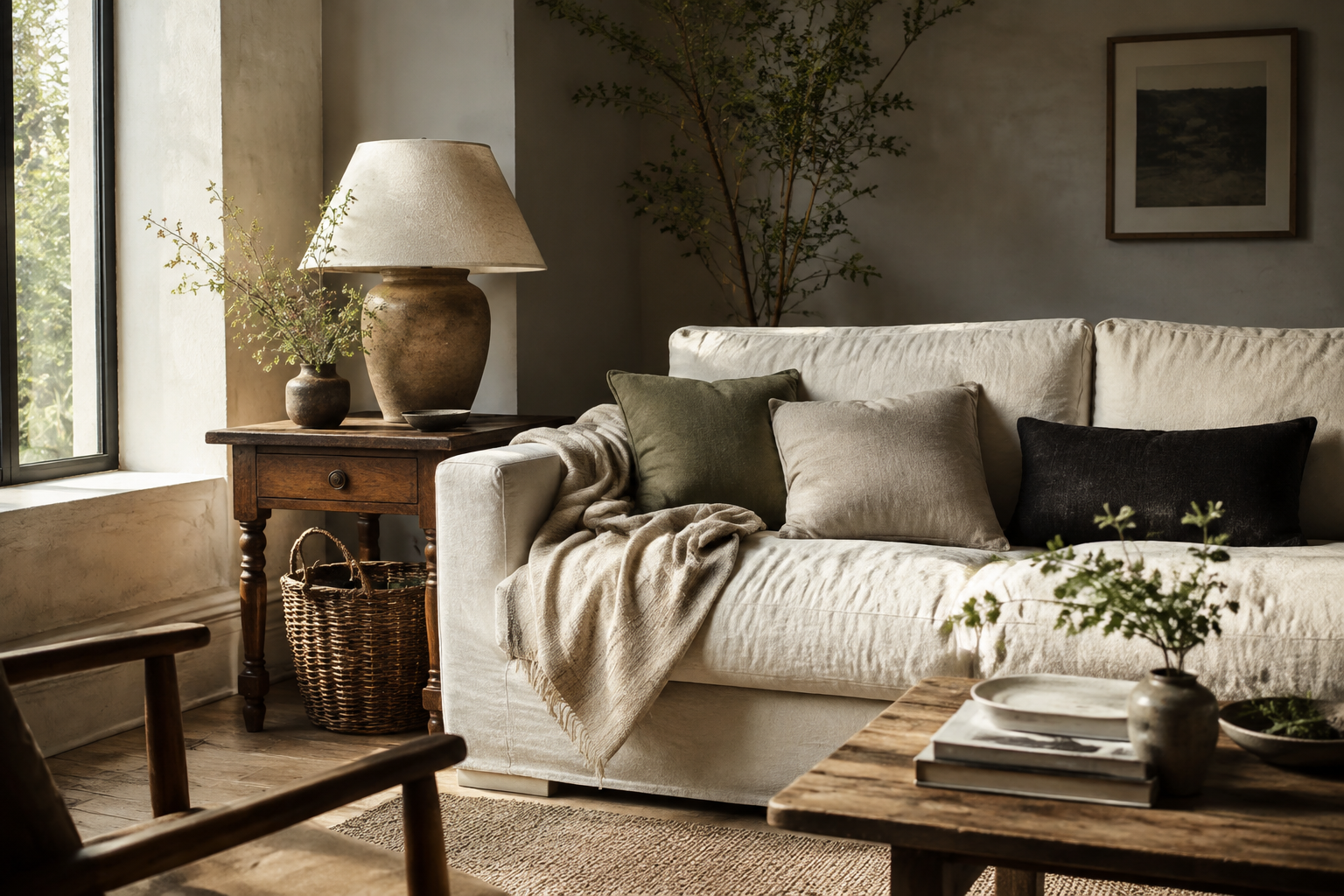
A room feels collected when its pieces appear to have earned their place over time. It feels decorated when the objects look coordinated but disconnected from the people, habits, and architecture around them.
The difference is not age, price, or the number of accessories. A collected room can be new and minimal. What matters is that it contains a clear point of view, useful objects, some variation, and enough continuity to keep the mixture coherent.
Collected does not mean cluttered
| A collected room | A room that may feel staged |
|---|---|
| Objects support daily routines or personal meaning | Surfaces are filled because they looked empty |
| Different periods and materials share a visual thread | Everything comes from one matching collection |
| Scale varies, but the room remains balanced | Many small objects compete equally for attention |
| There is room for the home to change | Every corner appears permanently “finished” |
The goal is not to manufacture a history the room does not have. It is to make thoughtful choices slowly enough that the result reflects your actual life.
1. Begin with the life of the room
Before choosing colors or buying furniture, observe what happens there. Where does everyone naturally sit? Which path needs to stay clear? Where do books, chargers, pet toys, or cups collect? Which seat receives comfortable light?
Write down the room’s three most important jobs. A living room might need to support conversation, television, and a child’s floor play. That list becomes the filter for every design decision.
Make useful things intentional: place a table within reach of the favorite chair, provide a lamp where someone reads, and put storage where objects are actually dropped. A room that respects habits immediately feels more believable. Explore related ideas in Decor.
2. Inventory what has already earned a place
Temporarily remove loose decor and identify the pieces you genuinely want to keep. Include objects that work well, carry a memory, fit the architecture, or simply make the room more comfortable.
For each item, ask:
- Does it serve the room’s jobs?
- Would I choose to keep it if nobody else saw the room?
- Is the problem the object—or its current placement?
- Does it need repair, a new shade, a different frame, or more space around it?
Moving familiar objects often produces more character than replacing them. An occasional table can become a nightstand; art can move to a quieter wall; scattered pottery can become one focused group.
3. Create a room map before a shopping list
Take four simple photos—one from each corner—and note the room’s largest visual areas: floor, walls, windows, main seating, lighting, and storage. Then identify the weakest layer.
| If the room lacks… | Resolve this layer first |
|---|---|
| Comfort or easy movement | Layout and furniture spacing |
| A focal point | Art, a mirror, fireplace treatment, or view |
| Warmth | Lighting, textiles, or natural materials |
| Order | Visible storage and fewer small objects |
| Personality | Meaningful art, books, handmade pieces, or collected finds |
Do not use accessories to disguise a layout problem. A correctly placed chair or better lamp can transform the room more than a shelf full of objects.
4. Choose one quiet thread
A mixture needs continuity. Select one or two elements to repeat gently: a warm wood undertone, olive green, aged metal, curved shapes, hand-thrown ceramics, or a simple stripe.
The repetition should be noticeable only after looking around. Three related moments are often enough. For example, a woven shade, cane chair, and basket share texture without forming a set. A round mirror, curved lamp, and oval bowl can soften a room dominated by rectangles.
Avoid repeating everything. If color, material, shape, pattern, and finish all match, the thread becomes a theme.
5. Mix ages without creating a costume
Rooms gain depth when not every object has the same age and finish. A clean-lined sofa may work beside a worn wooden stool; a modern lamp can sit on an inherited dresser; contemporary photography can hang in an older frame.
You do not need valuable antiques or objects pretending to be old. Secondhand furniture, family pieces, local craft, and repaired items can add variation honestly. Let evidence of age remain only when the piece is safe and functional.
Use contrast deliberately. Pair one visually detailed piece with quieter surroundings so its shape or patina can be seen. Several ornate objects crowded together lose their individual impact.
6. Layer texture before adding more decor
When a room feels flat, the missing ingredient is often surface variation rather than more objects. Compare what is already present: smooth paint, glass, metal, upholstery, wood grain, woven fiber, stone, paper, and plants.
If most surfaces are hard and reflective, add one soft or matte layer such as curtains, a rug, a paper shade, or a textile. If the room already contains many textures, introduce a quieter material to give the eye rest.
Texture should also match maintenance. A delicate pale rug may not support a muddy entry, pets, or young children. A collected home becomes more personal when its materials reflect the household rather than fight it.
7. Give meaningful objects breathing room
A photograph, travel find, handmade bowl, inherited clock, or group of books is easier to appreciate when it is not surrounded by unrelated filler. Choose a few objects for each visible surface and leave open space between compositions.
Vary height and visual weight, but do not treat odd-number groupings as a mandatory formula. A single substantial object can be stronger than three small ones. Useful items—coasters, reading glasses, or a remote—can remain visible if they are contained and easy to reach.
8. Let art be specific to you
Art does not need to match the sofa. It should hold attention, recall a place or person, support a local artist, document a family story, or simply be an image you want to continue seeing.
Before hanging, test the size with paper or painter’s tape. Relate the artwork to the furniture or wall area beneath it so it does not appear isolated. For a group, keep one quality consistent—spacing, frame family, medium, or tonal range—while allowing the works themselves to differ.
Frames can be changed gradually. A mismatched collection looks intentional when the differences repeat rather than appearing as one accidental outlier.
9. Make ordinary objects part of the design
The items used every day shape the room as much as formal decor. A comfortable throw, a basket that holds toys, a tray for remotes, and a reading lamp make a space feel cared for because they support real behavior.
Choose practical objects in materials related to the room and give them a dependable home. When storage, lighting, and comfort are resolved, fewer decorative objects are needed.
A welcoming room is not a finished performance. It is a place that makes everyday life feel a little better.
10. Keep one honest imperfection
Wood tones do not need to match exactly. Pillows do not need to be identical. A chair may show wear; books may lean; a handmade object may be asymmetrical. These differences prevent the room from feeling copied from a single photograph.
Imperfection is not an excuse for damage, instability, or poor function. Repair unsafe furniture, secure heavy objects, and replace materials that cannot support daily use. Keep the character, not the hazard.
11. Edit in rounds
Remove half the loose objects from a crowded surface and live with the quieter version for several days. If a corner feels empty, first ask whether it needs better light or a change in furniture placement.
Use photographs as diagnostic tools. A straight-on photo can reveal a rug that is too small, ten similarly sized objects, or a color that appears only once. Correct the large imbalance before purchasing a small accessory.
A four-week collected-room experiment
- Week one: observe routines and remove objects that do not belong.
- Week two: improve the layout, lighting, and storage using what you own.
- Week three: identify the room’s quiet visual thread and regroup meaningful pieces.
- Week four: buy or source only the one missing item that solves a documented problem.
This pause creates evidence. You may discover that the room needs a floor lamp rather than more decor, or a larger rug rather than new pillows.
Questions to ask before bringing something home
- Where exactly will it live?
- What function, memory, texture, or focal role does it add?
- Is the scale appropriate for that location?
- Does it relate to at least one existing element without duplicating everything?
- Can the household maintain, clean, store, or safely use it?
- Would removing something else create a better result?
Build the feeling slowly
Choose one corner. Remove what does not belong, add the light it needs, and place one object with use or meaning. Then stop and live with it.
When the room feels settled, explore five quiet ways to welcome a new season or the guide to choosing home accessories without adding clutter.
How this guide was developed: The framework separates layout, function, visual continuity, personal meaning, and editing so a collected room can evolve without depending on constant shopping. It is intended as a flexible process, not a prescription for a particular decorating style. Reviewed October 13, 2026.