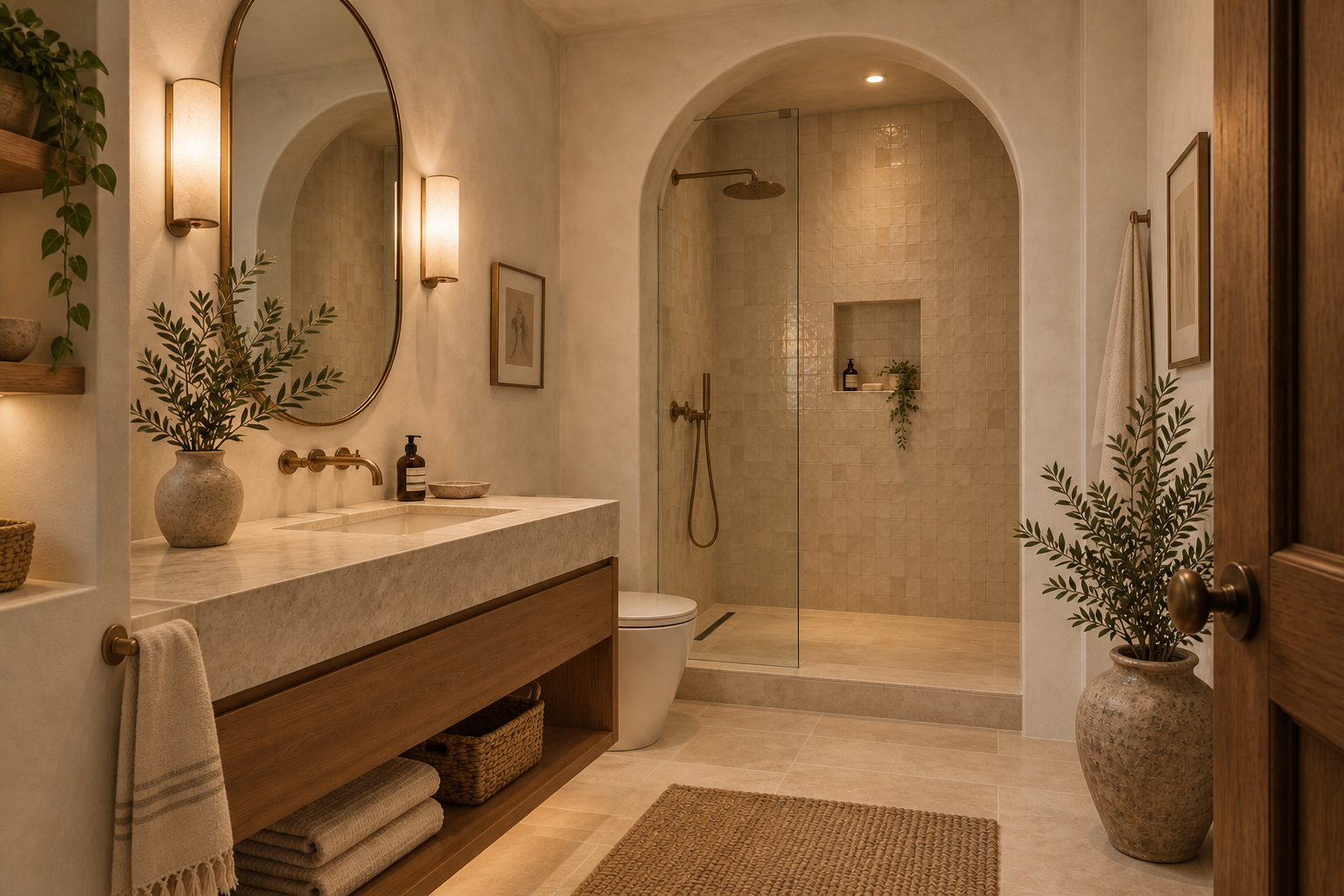
There is something about Mediterranean bathrooms that makes them feel instantly slower.
Maybe it is the softness of limewashed walls, the warmth of natural stone, the slightly imperfect surface of handmade tile, or the way aged brass catches the light without ever looking too polished. Whatever the reason, these spaces tend to have a quality that many modern bathrooms are missing: they feel calm before they feel impressive.
And that is exactly what makes them so beautiful.
A Mediterranean-inspired bathroom does not need to be oversized, dramatic, or filled with expensive finishes. In fact, the best ones often feel quite restrained. They rely on texture, shape, light, and materials rather than decoration. A rounded arch can do more than ten accessories. A warm plaster wall can feel more luxurious than a glossy feature tile. A simple wooden vanity can completely change the atmosphere of the room.
The goal is not to make your bathroom look themed or overly rustic. It is to create a space that feels collected, tactile, and quietly luxurious — somewhere between an old European villa and a very good boutique hotel.
Here are nine ideas to bring that feeling into your own bathroom.
Editorial note: the visual ideas below are inspiration, not construction instructions. Bathrooms are wet environments, so waterproofing, ventilation, electrical safety, slip resistance, and manufacturer-approved installation methods should be decided before decorative finishes.
The Mediterranean Look: Design Choice vs. Practical Requirement
| Design idea | What creates the look | What to verify first |
|---|---|---|
| Plaster-like walls | Soft movement and a matte finish | Product approval for the exact dry, damp, or wet location |
| Handmade-look tile | Variation in tone and surface | Floor/wall rating, slip resistance, grout, and waterproofing assembly |
| Natural wood vanity | Warm grain against stone and tile | Sealed edges, splash protection, ventilation, and cleaning requirements |
| Aged brass | Warm, low-shine metal | Living finish versus protected finish and compatible cleaners |
| Soft lighting | Layered light rather than one harsh fixture | Wet/damp-location rating and local electrical requirements |
| Open shower or arch | Architectural simplicity | Water containment, drainage, structure, and accessibility |
1. Start With Soft, Architectural Shapes
One of the easiest ways to create a Mediterranean feeling is through shape.
Arches are especially effective because they immediately soften the harder lines typically found in bathrooms. Showers, mirrors, doorways, wall niches, and even built-in shelving can all be gently rounded rather than sharply rectangular.
The reason this works so well is simple: bathrooms naturally contain a lot of straight lines. Tiles, counters, cabinetry, glass panels, and fixtures all tend to be quite geometric. Adding just one curved architectural element breaks up that rigidity and makes the room feel more relaxed.
You do not need multiple arches everywhere.
In fact, one strong arch is usually more elegant than several competing ones.
An arched shower opening, for example, can become the main visual feature of the room without requiring much else around it. Pair it with simple walls and minimal styling and suddenly the entire bathroom feels intentional.
If you are working with an existing bathroom and cannot change the architecture, you can still introduce this softness through an oval mirror, rounded lighting, curved faucets, or a gently shaped vanity.
The idea is not to force a Mediterranean motif.
It is to soften the room.
2. Choose Warm, Imperfect Tile
Perfectly uniform tile can look beautiful, but it often feels very contemporary.
Mediterranean interiors tend to come alive when the surfaces have a little variation.
Handmade-look zellige, tumbled stone, travertine, limestone, or subtly uneven ceramic tiles are all excellent options because they reflect light differently across the surface. Some areas appear slightly deeper, others softer, and the result feels layered rather than flat.
This is especially beautiful in showers.
A warm beige or creamy zellige tile can create a spa-like atmosphere without feeling overly decorative. The slight imperfections become part of the design.
And the best part is that you do not need to introduce bold color to make the space interesting.
Texture can do that work for you.
If you prefer a quieter look, choose a tile that stays within the same family as the walls and floor. Cream on cream, sand on beige, or soft taupe with limestone can feel incredibly sophisticated.
A useful rule is this:
The less contrast you use in color, the more interesting the texture should be.
That is what keeps a neutral bathroom from feeling bland.
Do not confuse beautiful tile with a waterproof shower
Tile and grout are the visible finish; the assembly behind them manages water. The Tile Council of North America specifically notes that grout joints are not waterproof and that wet areas must rely on the selected installation method and substrate to protect surrounding construction.
- Confirm that the exact tile is approved for floors, walls, showers, or exterior use as applicable.
- Ask how surface variation affects cleaning and whether sealing is required.
- For floors, compare slip-resistance information rather than choosing by appearance alone.
- Keep spare tile from the same production batch for future repairs.
3. Keep the Color Palette Tonal
Mediterranean bathrooms rarely need a complicated palette.
Instead, they often work best when everything feels like a variation of the same natural spectrum: ivory, warm white, sand, beige, clay, honey-toned wood, muted brown, olive green, and aged brass.
This tonal approach makes the room feel calm because the eye is not constantly jumping between strong contrasts.
It also gives materials more importance.
When your walls, floor, and shower all sit within similar warm tones, you begin to notice the grain of the wood, the texture of the stone, the sheen of the tile, and the warmth of the metal.
That is where the richness comes from.
If your bathroom currently feels cold or overly stark, one of the easiest changes is simply to move away from bright white and cool gray.
Warm white walls, creamy stone, and natural timber can completely alter the mood without requiring a major redesign.
This does not mean everything needs to match exactly.
In fact, it is better when it does not.
The room should feel coordinated, not manufactured.
Think of it more like layering shades found in nature rather than selecting colors from a perfectly matched swatch.
4. Bring In Natural Wood
Bathrooms are full of hard materials.
Stone. Tile. Glass. Metal. Porcelain.
That is why wood makes such a difference.
A warm oak or walnut vanity instantly gives the room a more relaxed and residential feeling. It introduces visual warmth and makes the bathroom feel less sterile.
Floating vanities work particularly well in Mediterranean-inspired spaces because they keep the room feeling light while still bringing in that natural material.
An open shelf underneath can also add softness when styled with folded towels, baskets, or simple storage.
The key is choosing wood that looks natural.
Very glossy finishes or overly orange stains can work against the calm atmosphere you are trying to create. Look for visible grain, warm undertones, and matte or low-sheen finishes.
If a full wooden vanity is not realistic, smaller touches still work beautifully.
A stool inside the shower, a wooden tray near the bath, a simple frame, or even a small shelf can create the same effect.
It is not about adding a lot of wood.
It is about creating contrast against all those hard surfaces.
Use wood where it can realistically stay dry
A wood-look vanity is not automatically bathroom-ready. Ask how the cabinet core, veneer, edge banding, finish, and hardware respond to humidity and splashes. Seal vulnerable cut edges and follow the manufacturer’s care instructions. In a frequently wet zone, a convincing wood-look porcelain or moisture-resistant cabinet finish may achieve the warmth with less maintenance.
5. Use Aged Brass Instead of Highly Polished Finishes
There is a subtle difference between a bathroom that looks luxurious and one that feels luxurious.
Metal finishes play a surprisingly important role.
Aged brass, brushed brass, antique bronze, and other warmer metals tend to feel softer and more lived-in than high-shine chrome.
They also pair beautifully with cream stone, warm plaster, and wood.
The trick is restraint.
You do not need every object in the room to be brass.
A faucet, shower system, mirror frame, or pair of sconces is usually enough.
When repeated lightly throughout the space, warm metal acts almost like jewelry. It adds depth without becoming the focal point.
Another advantage is that aged and brushed finishes tend to suit the slightly imperfect quality of Mediterranean interiors.
They are not trying to look pristine.
And that is part of the charm.
6. Make the Lighting Feel Like Part of the Design
Good bathroom lighting is not only functional.
It changes the entire atmosphere of the room.
Many bathrooms rely heavily on bright overhead lighting, which is useful but rarely flattering or relaxing. A more layered approach feels much more luxurious.
Wall sconces beside or above a mirror immediately create a softer mood. Warm concealed lighting under a vanity or inside a niche can also make the space feel more considered.
Natural light, of course, is ideal whenever possible.
A small window, skylight, or frosted opening can completely transform textured walls and handmade tile because the light changes throughout the day.
If you are choosing bulbs, warmer temperatures tend to work better with this style than very cool white lighting.
You want the room to glow.
Not feel like a laboratory.
One of the simplest ways to make an ordinary bathroom feel more expensive is to stop thinking of lighting only as a practical requirement and start treating it as part of the interior design.
Plan light in three layers
- Ambient: comfortable overall illumination for moving through the room.
- Task: even light at the mirror, ideally reaching the face from more than one direction.
- Accent: optional light for a niche, textured wall, or the underside of a vanity.
Check that every fixture is rated for its actual location. A decorative sconce suitable beside a dry vanity may not be appropriate inside a shower or directly above a tub. Local electrical rules and manufacturer instructions take priority over the mood board.
7. Keep the Styling Minimal
This may be the most important point of all.
Mediterranean-inspired bathrooms usually look their best when they are not overstyled.
You do not need a tray full of candles, three vases, stacks of decorative towels, five bath products, and a collection of little objects on every available surface.
A few thoughtful pieces are enough.
An amber soap bottle. A small ceramic bowl. A folded linen towel. A branch of olive or eucalyptus. One beautiful woven basket.
Done.
The empty space around those objects is part of the design.
This is especially important in smaller bathrooms, where visual clutter can quickly make the room feel cramped.
If you want your bathroom to feel more serene, one of the best things you can do may actually be removing things rather than adding them.
Store daily products away.
Keep counters mostly clear.
Let the materials speak.
A beautiful stone counter does not need much decoration sitting on top of it.
8. Add Greenery — But Sparingly
Plants bring life to neutral spaces, especially when the palette is dominated by beige, cream, and wood.
But Mediterranean bathrooms tend to look more sophisticated when greenery is used in a restrained way.
A single trailing plant from a shower niche, a branch of olive leaves in a ceramic vase, or one small potted plant can be enough.
You want the greenery to soften the room, not turn it into an indoor jungle.
This is another area where scale matters.
A few long branches can often look more elegant than several small decorative plants scattered around the room.
And if your bathroom does not get enough natural light for real plants, good-quality dried branches can work beautifully too.
The goal is simply to introduce a touch of organic movement.
9. Let the Bathroom Feel Slightly Imperfect
Perhaps the most beautiful quality of Mediterranean interiors is that they do not usually feel overly controlled.
The plaster may have subtle variation.
The tile may not be perfectly uniform.
The wood grain is visible.
The stone has marks and movement.
Even the metal may develop a patina over time.
This gives the room character.
There is a tendency in modern renovation to make every surface extremely smooth, symmetrical, and consistent. But sometimes that perfection is exactly what makes a room feel less inviting.
A little irregularity gives the eye something to notice.
It makes the space feel human.
This does not mean the bathroom should look unfinished or messy. The best Mediterranean-inspired spaces are actually quite refined.
They simply allow natural materials to look natural.
And that distinction is important.
The Part That Photographs Cannot Show: Ventilation and Daily Use
A calm bathroom will not stay calm if moisture lingers, towels never dry, and daily products have nowhere to go. The U.S. EPA recommends a properly functioning bathroom exhaust fan that vents directly outdoors—not into an attic or another enclosed space—to remove moisture and help reduce mold and mildew risk. See the EPA’s bathroom remodeling and ventilation guidance.
- Confirm the fan actually exhausts outdoors and is sized for the room and duct run.
- Use closed storage for backup products, cleaning supplies, and visual clutter.
- Provide hooks or rails where towels can spread out and dry.
- Leave comfortable circulation around doors, drawers, and shower screens.
- Choose surfaces based on the cleaning routine you will realistically maintain.
Three Ways to Create the Look at Different Budgets
Small update
Keep the existing tile and plumbing. Introduce one rounded mirror, warmer bulbs, coordinated towels, a quieter countertop, and a single wood or ceramic accent. This works best when the room is already technically sound.
Mid-range refresh
Replace the vanity, mirror, sconces, hardware, and wall color while leaving expensive plumbing locations unchanged. Spend on the element with the most visual weight—usually the vanity or shower surround—instead of distributing the budget across many accessories.
Full renovation
Plan waterproofing, drainage, ventilation, lighting, storage, and accessibility before choosing decorative finishes. Architectural curves and plaster-like surfaces are most convincing when integrated into the construction rather than added as isolated motifs.
Technical Sources and Further Reading
- Tile Council of North America: Ceramic Tile Installation FAQs
- TCNA: 2026 Handbook for Ceramic, Glass, and Stone Tile Installation
- U.S. EPA: Bathroom Remodeling, Ventilation, and Indoor Air Quality
- ENERGY STAR: Residential Ventilation Fans
Last editorial review: October 13, 2026. Product approvals, building requirements, and installation methods vary; confirm the details for your location and exact materials.
The Secret Is Less, But Better
If there is one idea to take from Mediterranean bathroom design, it is this: you do not need more things.
You need better choices.
One beautiful vanity instead of several decorative elements.
One architectural arch instead of complicated wall detailing.
One warm metal finish used consistently.
One textured tile with real visual depth.
One plant.
One good light.
That restraint is what creates the feeling of quiet luxury.
And perhaps that is why these bathrooms photograph so beautifully, too. There is enough detail to feel interesting, but enough breathing room to make you want to stay.
When you walk into a well-designed Mediterranean bathroom, the first thing you notice is not necessarily the sink or the tile.
You notice the atmosphere.
Warm.
Soft.
Calm.
A little earthy.
A little European.
And very far from rushed.
That is ultimately what makes the style so appealing.
It turns one of the most practical rooms in the house into a place that feels like a small retreat.
And fortunately, you do not need a villa overlooking the Mediterranean to create it.
Sometimes all it takes is warmer materials, softer shapes, better lighting, and the confidence to leave a little space empty.