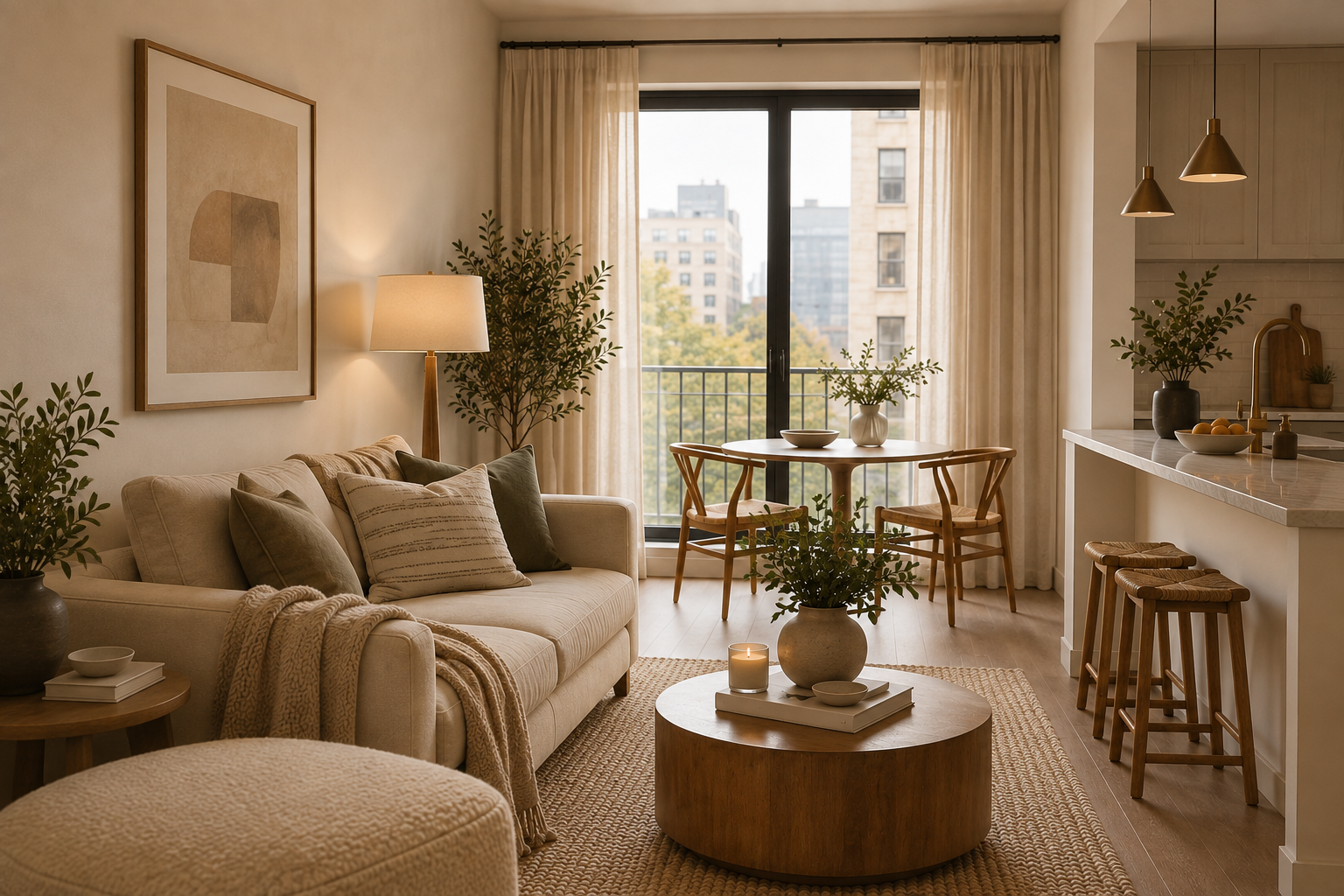
There’s a moment so many of us know well: that first move into a place that’s truly yours, whether you’re living alone or starting a home with someone else.
You fall in love with the space almost instantly. You’re proud of taking that step, you can’t contain the excitement, and suddenly all you want to do is make it feel like you.
Then comes the first decorating hurdle: small spaces are much harder to get right than they look.
The secret isn’t filling every corner or buying everything at once. It’s choosing fewer pieces, choosing them better, and making decisions around your own taste.
The goal is a home that feels beautiful, comfortable, easy to live in, and personal enough that you’re genuinely excited to invite people over.
1. Start With One Clear Direction
A small apartment doesn’t need a strict design label, but it does benefit from a clear point of view.
Before buying anything, think about how you want the space to feel. Warm and relaxed? Clean and minimal? Rustic and collected? Soft and Mediterranean? Modern with a few vintage touches?
You don’t need to name the style perfectly. You just need a direction.
In a smaller space, too many competing styles, colors, and finishes become noticeable very quickly. A simple visual thread — repeated wood tones, a consistent color palette, or a few recurring materials — helps the whole apartment feel more intentional.
Start with the feeling you want to create, then let your choices support it.
2. Buy Fewer, Better-Sized Pieces
One of the easiest mistakes to make in a small apartment is assuming that everything needs to be tiny.
Too many small pieces can actually make a room feel busier and more cramped. A handful of well-scaled pieces often creates a calmer, more expensive look.
Instead of squeezing in several side tables, chairs, baskets, and decorative objects, focus on a few pieces that do their job well.
A properly sized sofa. A coffee table with presence. One good floor lamp. A rug that actually anchors the room.
Fewer pieces give each one more room to matter.
3. Pay Attention to Scale
Scale is one of those design details that quietly changes everything.
A rug that’s too small can make the furniture feel disconnected. Curtains that stop awkwardly at the window can visually shorten the walls. Tiny artwork on a large empty wall can make the room feel unfinished.
Small apartment does not mean small everything.
Choose pieces that relate properly to the room and to each other. Let the front legs of the sofa sit on the rug. Hang curtains high and wide. Use artwork that has enough visual weight for the wall.
Good scale makes a space feel deliberate rather than improvised.
4. Let the Floor Breathe
Empty space is not wasted space. In a small home, it is part of the design.
When every inch of floor is covered by furniture, storage, baskets, stools, and decor, the room can start to feel crowded even if everything is technically organized.
Try to preserve some visible stretches of flooring and a few clear pathways through the room.
That visual breathing room helps the eye move through the space and makes the apartment feel larger, calmer, and more refined.
Not every corner needs to be filled.
Sometimes the most expensive-looking decision is simply leaving something out.
5. Use Curtains to Add Height
Curtains can dramatically change the proportions of a room.
Instead of hanging the rod directly above the window frame, place it closer to the ceiling and extend it slightly beyond the sides of the window. Choose curtains that reach the floor.
This draws the eye upward and makes the walls feel taller.
It also gives the room a more finished look, even if the curtains themselves are simple.
The difference between a room that feels temporary and one that feels thoughtfully designed can be surprisingly small.
6. Layer Your Lighting
Relying only on one overhead light can make even a beautifully decorated apartment feel flat.
Layering light creates depth, warmth, and atmosphere.
Use a combination of ceiling lighting, floor lamps, table lamps, and softer ambient light. You don’t need all of them in every room; even adding one lamp beside the sofa can completely change how the space feels at night.
Good lighting doesn’t just help you see the room.
It changes how the room feels.
And in a small apartment, that shift in atmosphere can make a huge difference.
7. Choose Materials That Add Warmth
When there are fewer objects in a room, the materials you choose become more noticeable.
Wood, linen, ceramic, stone, aged metal, woven fibers, and natural textures can add richness without adding clutter.
This doesn’t mean everything has to be expensive or handmade.
It simply means paying attention to texture and finish rather than buying several objects that all feel visually flat or overly synthetic.
A wooden table, a linen curtain, a ceramic lamp, and a woven basket can do more for a room than ten small decorative accessories.
Texture creates depth without taking up extra space.
8. Hide What You Don’t Need to See
Small spaces become visually busy very quickly.
The answer isn’t necessarily owning fewer things. It’s giving everyday things somewhere to go.
Closed storage, drawers, baskets, furniture with hidden compartments, and simple drop zones can make a huge difference.
Think about what tends to collect in your space: keys, chargers, shoes, paperwork, pet supplies, blankets, cleaning products.
Then give those things a designated home.
The goal isn’t an empty home.
It’s a home where everyday things have somewhere to go.
9. Add Personality With Things You Actually Love
A home can look expensive and still feel personal.
In fact, the most memorable spaces usually are.
Instead of filling shelves with generic decor just because they look empty, leave room for objects that mean something to you: books, art, photographs, travel finds, inherited pieces, ceramics, or colors you genuinely love.
A smaller number of personal objects often feels more sophisticated than a shelf filled with things chosen only because they match.
Expensive-looking and personal are not opposites.
Your taste is what makes the space yours.
10. Don’t Finish It All at Once
That first apartment excitement can make you want to finish everything immediately.
But some of the best homes feel collected because they were built slowly.
Buy the essentials first. Live in the space. Notice where you naturally sit, where clutter collects, what you actually use, and what feels missing.
You may discover that the side table you thought you needed would only get in the way, or that the empty wall actually needs a large piece of art rather than several small decorations.
Give yourself permission to live in the space before you finish decorating it.
A home usually gets better when it has time to evolve.
A Small Apartment Can Still Feel Thoughtful, Warm, and Elevated
Making a small apartment feel more expensive isn’t about buying luxury furniture or making the space look like someone else’s home.
It’s about restraint, proportion, warmth, and intention.
Choose fewer things. Choose them well. Pay attention to scale. Leave some breathing room. And most importantly, make decisions around the way you actually want to live.
Your first apartment doesn’t need to look finished on day one.
It needs to feel like the beginning of a home you’re excited to build.
Use a measurement-first buying sequence
| Buy or decide first | Why it comes first | What to record |
|---|---|---|
| Circulation and furniture layout | Determines what can physically fit | Door swings, walking paths, outlets, vents |
| Largest necessary furniture | Sets the scale for everything else | Width, depth, height, delivery route |
| Rug and curtains | Connect the large visual planes | Furniture footprint, rod position, finished length |
| Lighting | Supports tasks and changes the evening atmosphere | Outlet locations, task positions, cord paths |
| Storage and accessories | Should solve observed needs | Actual item volume and remaining surfaces |
Measure the elevator, staircase, hallway turns, and entrance—not only the room. A sofa that fits the wall but cannot reach the apartment is not the right scale.
Test the layout without buying furniture
Use painter’s tape or flattened boxes to mark the footprint of a sofa, table, rug, and storage unit. Open every nearby door and walk the normal route through the room. Sit where the chair would be and check the view, lighting, and access to a surface.
Leave the outline in place for a day if possible. This reveals whether the furniture interrupts cleaning, blocks a cabinet, narrows a path, or makes another daily task awkward.
Make rental-friendly choices deliberately
Read the lease before drilling, painting, replacing fixtures, or applying adhesive products. Removable does not always mean damage-free, especially on fresh, textured, or poorly bonded paint. Test products in an inconspicuous location and follow the manufacturer’s instructions.
Freestanding lighting, full-length curtains on approved hardware, art leaned on a secure surface, and furniture that provides closed storage can create a finished home without permanent alterations. Keep original hardware labeled and stored safely if the lease permits temporary replacement.
Prioritize the changes that read as “finished”
- Correct obvious scale problems before adding decor.
- Create one clear path through each room.
- Use at least two useful light sources in the main living area.
- Contain exposed cables and recurring clutter safely.
- Repeat one color, material, or shape in a few locations.
- Leave enough open space for the apartment to function.
These changes usually create more visual calm than buying a coordinated set of small accessories.
A seven-day apartment audit
Before the next purchase, note every moment when the home creates friction for one week. Record where you lack a surface, light, seat, outlet, privacy, or storage target. At the end of the week, rank the problems by frequency and consequence.
Buy only for the highest-ranked problem and reassess. This creates a home around observed needs rather than an imagined finished photograph.
For related decisions, use the guide to making a room feel collected rather than decorated and the accessory audit for scale, function, and restraint.
How this guide was developed: The recommendations prioritize circulation, scale, rental constraints, lighting, storage, and observed household behavior. “More expensive” is treated as visual coherence and durable function—not a promise that a particular purchase or style signals wealth. Reviewed October 13, 2026.