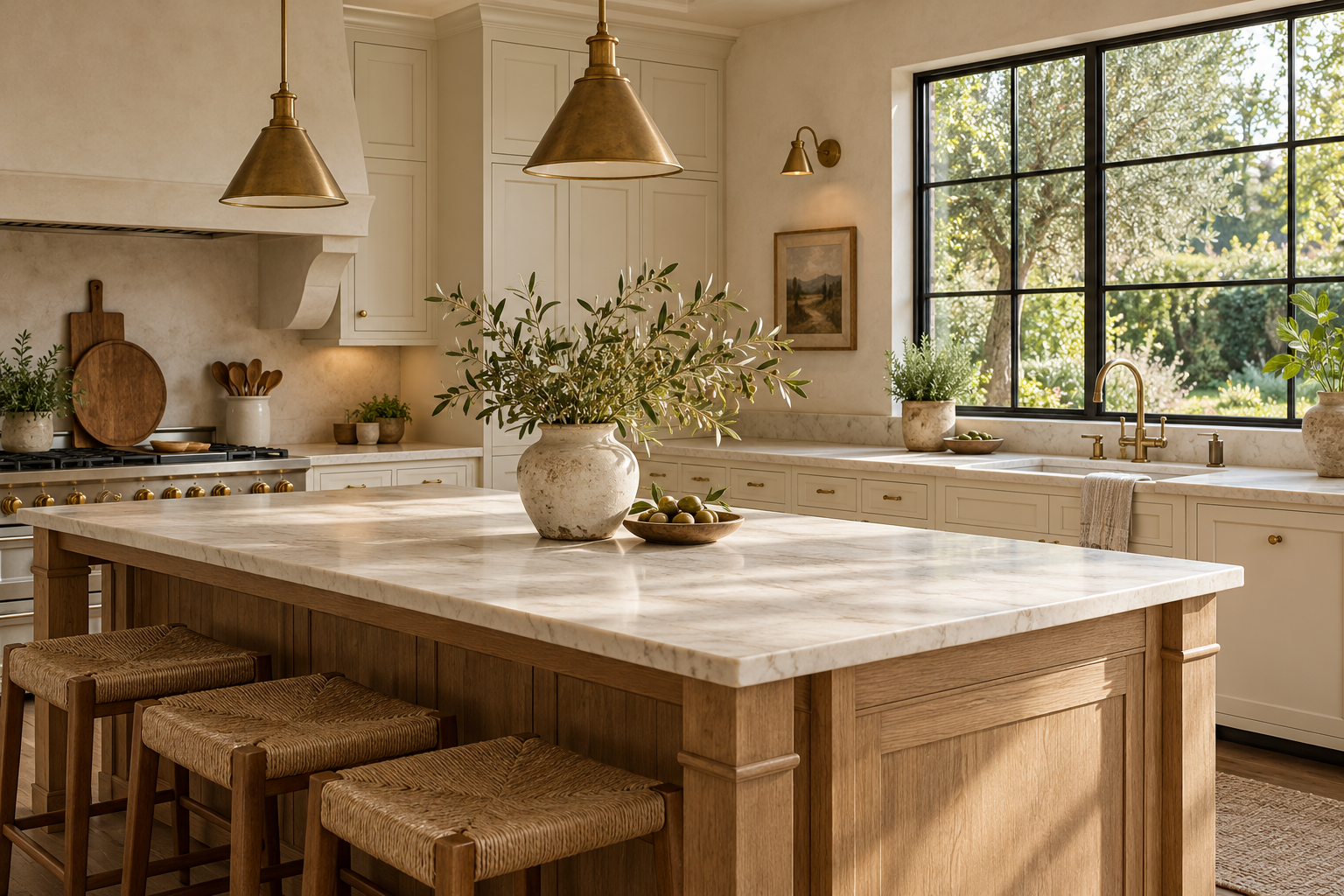
A countertop is asked to be several things at once: a work surface, a landing place, a serving table, and one of the largest visual elements in the kitchen.
It will meet hot cookware, coffee rings, citrus, grocery bags, homework, and the occasional object placed down much harder than intended. It also has to look convincing beside the cabinets, floor, backsplash, and light that already exist.
That makes the best countertop less about finding an indestructible material and more about choosing the kind of maintenance—and the kind of aging—you can comfortably live with.
This guide compares engineered quartz, granite, marble, butcher block, quartzite, soapstone, porcelain slabs, and laminate by daily performance, repairability, visual longevity, and installed complexity.
Editorial note: Material composition, fabrication, sealing, support, heat limits, care instructions, warranties, and local requirements vary. Confirm the exact product with its manufacturer and use an appropriately qualified fabricator and installer.
Begin With Four Honest Questions
- Which marks would bother you? A dull etch on marble, a scorch on wood, a visible seam, and a chip at a sink cutout are very different kinds of wear.
- What happens in this kitchen every day? Frequent cooking, baking, children, entertaining, direct sunlight, and a sink that is always busy change the answer.
- How much maintenance will actually happen? Choose for the household you have, not the ideal routine you hope to begin after installation.
- What does the complete installed system require? The slab is only one part of the project. Cabinets, support, seams, cutouts, edges, backsplash conditions, and fabrication can change both performance and cost.
A surface that suits the room but fights the household will never feel effortless. The goal is not perfection; it is predictable behavior.
Quartz, Granite, Marble, and Butcher Block at a Glance
| Decision factor | Engineered quartz | Granite | Marble | Butcher block |
|---|---|---|---|---|
| Visual character | Controlled color and pattern | Natural mineral variation | Soft veining and depth | Warm grain and visible joints |
| Everyday staining | Highly resistant; product-specific care still applies | Generally resistant; absorption varies | More vulnerable to stains and acids | Depends strongly on finish and prompt cleanup |
| Heat | Use trivets; resin and thermal shock can be damaged | Heat resistant, but localized thermal shock is still possible | Use trivets and follow stone-care guidance | Can scorch or discolor |
| Visible wear | Usually changes little | Usually changes little | Etches, scratches, and develops patina | Scratches, dents, darkens, and can be renewed |
| Routine maintenance | Low; no periodic sealing for most products | Cleaning plus sealing only when the specific stone needs it | Careful cleaning; sealing may improve stain resistance but not stop etching | Oiling or finish maintenance, depending on the system |
| Repairability | Professional repairs may remain visible | Small chips may be professionally repaired | Can be refinished professionally; patina remains part of the choice | Many finishes can be sanded and renewed |
| Best fit | Predictable color and low upkeep | Durable natural stone with variation | Owners who value beauty and patina over pristine perfection | Warmth, repairability, and lower-commitment character |
Engineered Quartz: Predictable and Low-Maintenance
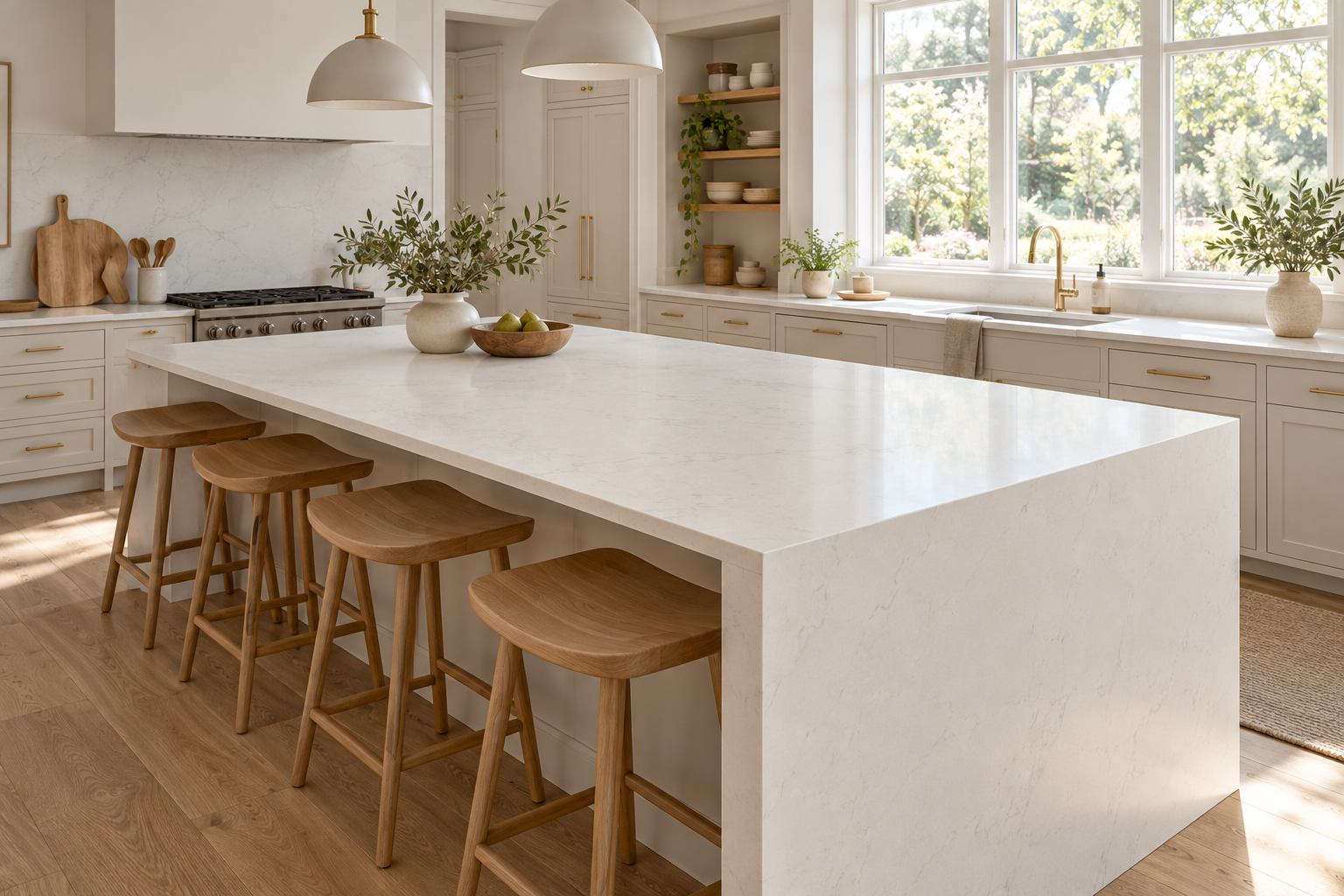
Engineered quartz combines mineral aggregate with binders and pigments to create slabs with controlled color and pattern. Formulas vary considerably, so the name “quartz” does not describe one universal composition or performance limit.
Its greatest advantage is predictability. If a kitchen has a long perimeter and a large island, a consistent pattern can make it easier to coordinate several pieces without asking natural veining to line up perfectly. The surface is nonporous and typically does not require sealing.
What it handles well
- Everyday spills when they are cleaned promptly
- Busy kitchens that benefit from low routine maintenance
- Long runs where predictable color matters
- Homeowners who want a stone-like appearance without natural-stone variation
What can eventually mark it
Quartz is heat resistant, not heat proof. Resin-containing surfaces can discolor or crack from extreme heat or rapid temperature changes. Use a trivet under hot pans, electric skillets, slow cookers, and countertop ovens, and follow the exact manufacturer’s limits. A major manufacturer’s care guidance, for example, explicitly calls for hot pads or trivets.
Quartz also develops little natural patina. That is an advantage when the pattern is restrained, but a very dramatic printed vein may remain physically intact long after its style feels tied to one renovation era.
- Request the exact product name, technical information, warranty, and care sheet.
- Confirm seam placement and how the pattern will continue across joins.
- Check whether the chosen color and formulation are approved for direct sunlight or outdoor use.
Granite: Natural Variation With Practical Durability
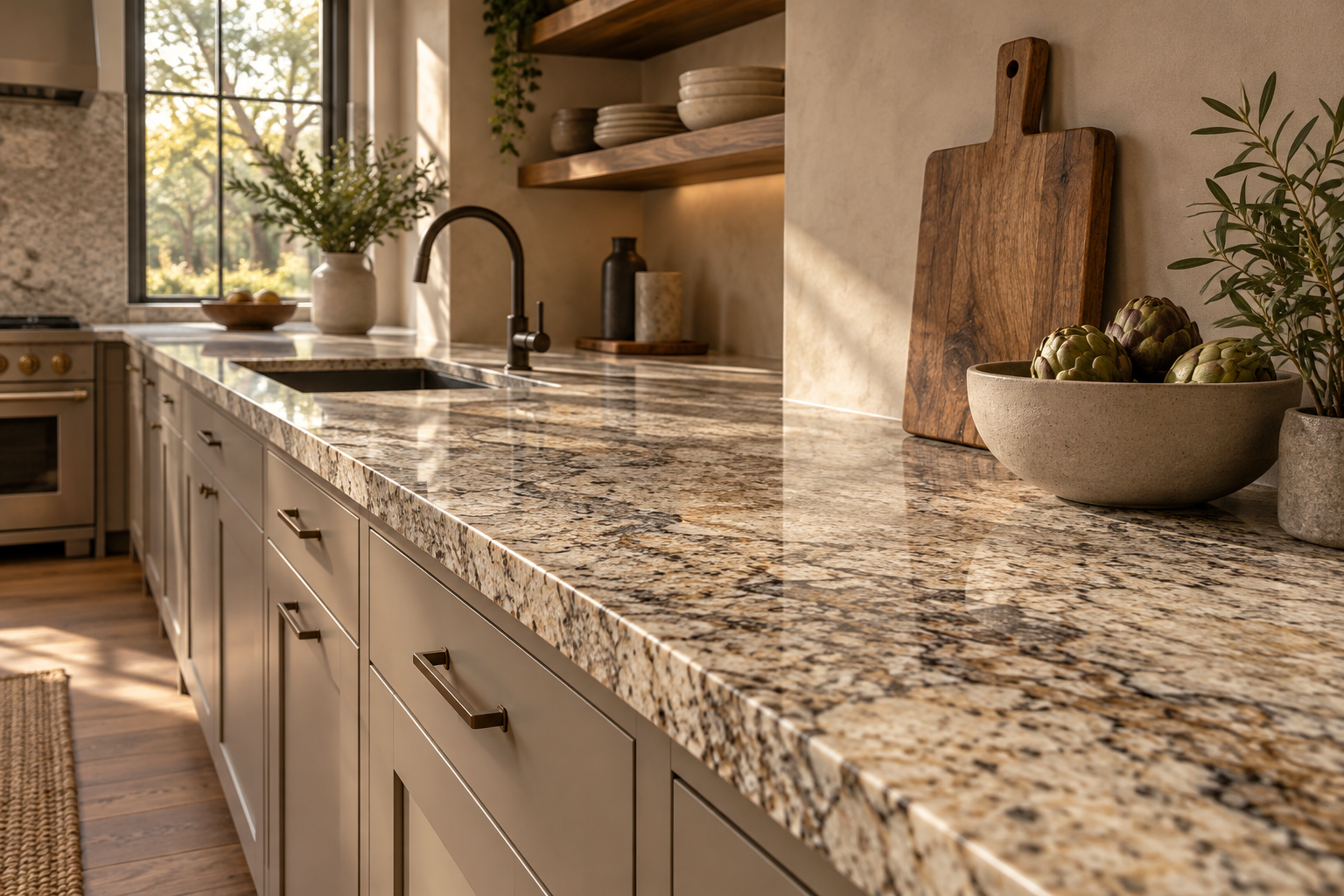
Granite is natural stone, so the exact slab matters more than the small showroom sample. Mineral flecks, color changes, fissures, and movement can be quiet or dramatic. Those variations are not printed defects; they are the material.
In daily use, granite is valued for strong heat, scratch, and wear resistance. It can still chip at exposed corners or around cutouts, and localized thermal shock is possible, so trivets remain a sensible habit.
The maintenance reality
Do not assume every granite needs frequent sealing. Density, mineral composition, resin treatment, finish, and use vary. The Natural Stone Institute notes that many granite countertops do not need sealing, although some stones receive additional stain resistance from an appropriate impregnating sealer.
Ask the fabricator what the exact stone requires and which product is suitable for a food-preparation area. A sealer can improve stain resistance; it does not make natural stone completely stain proof.
- View and approve the actual slab before cutting.
- Ask the fabricator to mark seam locations and major veins on the template.
- Choose moderate movement when visual longevity matters more than drama.
- Keep an offcut when practical for future color matching or repair assessment.
Marble: Beautiful Because It Changes
Marble brings a soft, luminous depth that is difficult to reproduce exactly. It works naturally in traditional, farmhouse, Mediterranean, and organic-modern rooms; our guide to Organic Modern and Mediterranean style explains how those rooms use natural variation differently.
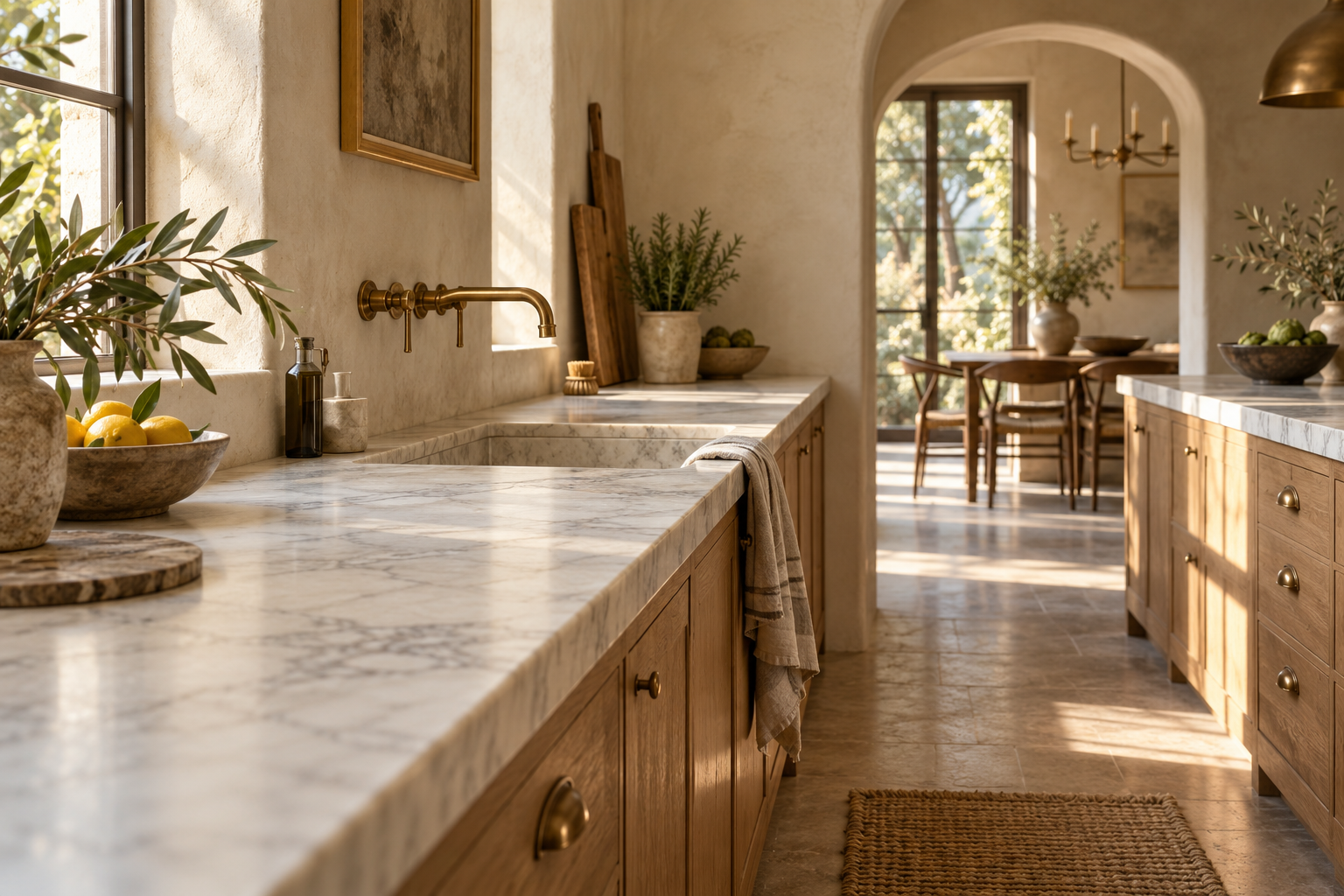
The tradeoff is chemical sensitivity. Marble is largely calcium carbonate, so acids such as lemon, vinegar, wine, and tomato can etch the finish. Etching is a change in the surface sheen, not the same thing as a stain. A sealer may improve stain resistance, but it does not prevent acid etching.
For some households, the first dull ring feels like damage. For others, the gradual accumulation of marks is exactly why an old marble counter becomes more convincing with time.
Who will be happiest with it
- Someone who prefers natural depth to visual uniformity
- A household comfortable with patina and professional refinishing when needed
- A baker who values a cool work surface and understands the care requirements
- An owner willing to wipe spills promptly without expecting the counter to remain pristine
A honed finish can make the contrast between new etches and the surrounding sheen less obvious than a highly polished surface, but it does not prevent marks. Compare finish samples and cleaning instructions for the exact stone.
Butcher Block: Warm, Repairable, and Maintenance-Dependent
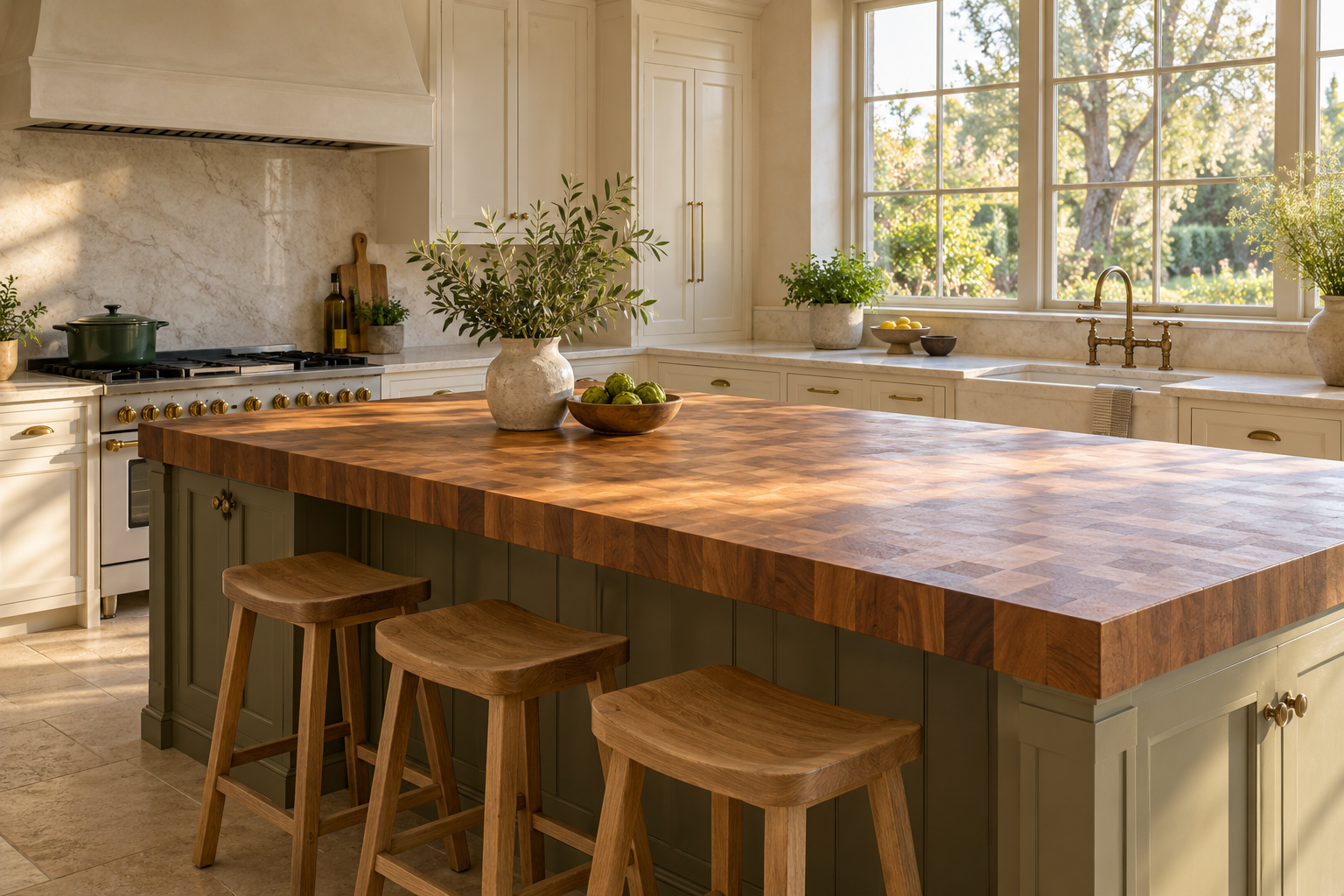
Wood changes the emotional temperature of a kitchen. It softens painted cabinets, metal appliances, tile, and stone, and it belongs naturally in the restrained version of farmhouse style that relies on honest materials rather than themed decoration.
It also asks more from the owner. Water can darken joints or damage an inadequately protected surface, heat can scorch it, and knives can leave visible cuts. The advantage is repairability: many wood-counter systems can be sanded and renewed instead of replaced.
The finish determines the routine
Penetrating oil finishes are relatively easy to refresh but require regular attention. Film-forming finishes may provide stronger moisture resistance but can be harder to repair invisibly. Use only a finish approved by its manufacturer for the intended installation and food-contact conditions.
Do not assume every wood countertop is intended to function as a cutting board. Use a separate board for raw meat and follow appropriate cleaning and cross-contamination practices. Around sinks and dishwashers, inspect caulk, end grain, seams, and standing-water habits carefully.
For many kitchens, butcher block works best on an island, baking station, or bar while a less water-sensitive material handles the sink and range.
Other Countertop Materials Worth Comparing
Quartzite
True quartzite is a natural metamorphic stone that can be exceptionally hard and durable, often with movement that resembles marble. Trade names can be confusing, and stones sold under similar names may behave differently. Ask the supplier for the geological classification, absorption and performance information, and care requirements. If a test is appropriate, use an approved offcut and the fabricator’s instructions rather than applying household acid to a finished slab.
Soapstone
Soapstone is nonporous and highly resistant to ordinary kitchen acids and heat, but it is softer than granite or quartzite. It can scratch and dent, and its gray-green color often deepens with mineral oil or repeated use. Light scratches may be renewed, which makes the material appealing to people who accept visible change.
Porcelain slabs
Large-format porcelain slabs offer strong resistance to heat, staining, and surface scratching, with printed designs that can imitate stone. Edges and cutouts require experienced fabrication because chipping is possible, and pattern repetition or unrealistic veining can undermine the effect. As with porcelain flooring, a subtle pattern usually remains visually flexible for longer.
Laminate
Laminate is a legitimate budget choice, not a failed version of stone. It is light, available in many patterns, and relatively straightforward to replace. Heat, knife cuts, swollen seams, and damaged edges are harder to repair, so use trivets and cutting boards and pay close attention around sinks.
Fabrication Is Part of the Countertop
Two kitchens using the same slab can perform differently because of templating, support, cutouts, seams, and installation. Before approving the order, ask the fabricator to review:
- Cabinet condition and level: heavy surfaces need a stable, appropriately prepared base.
- Overhangs and seating: support requirements depend on material, thickness, projection, and local practice. Do not assume a large island can cantilever without brackets or concealed support.
- Sink and cooktop cutouts: narrow areas and inside corners can be vulnerable. Confirm corner radii, rails, support, and appliance clearances.
- Seams: ask how many there will be, where they will fall, how wide they may appear, and how the pattern will meet.
- Faucet and accessory holes: finalize dimensions and locations before fabrication.
- Wall conditions: an uneven wall can affect the backsplash and rear edge. If you are deciding between those finishes, read our comparison of paint and tile in the kitchen.
- On-site cutting: ask what work will occur inside the home and how dust, ventilation, and cleanup will be controlled.
Color, Undertone, and the Amount of Counter You Will See
A small sample can be deceptive. A few gray veins may feel quiet in your hand and become the main pattern in a large U-shaped kitchen. A nearly black surface may look elegant under showroom lighting and reveal every water spot beside a sunny window.
Light counters
Cream, warm white, and pale stone can reflect light and reduce the visual weight of upper and lower cabinets. They are particularly helpful in smaller kitchens, although an all-white room still needs texture and contrast to avoid feeling flat.
Medium tones
Warm taupe, soft beige, quiet granite, soapstone gray, and natural wood often provide the broadest long-term flexibility. They anchor the room without making the counter its only focal point.
Dark counters
Black, charcoal, and deep green can be striking, but fingerprints, dust, hard-water residue, crumbs, and cleaning streaks may become more visible depending on the finish. Check the surface in the room’s real daylight and evening lighting. If the entire kitchen feels dim, diagnose the light before committing to a darker plane; our guide to brightening a dark room explains where to begin.
Warm or neutral undertones usually work easily with cream cabinetry, natural wood, brass, terracotta, olive, and muted paint colors. Cool blue-gray undertones can be beautiful, but they need to relate deliberately to the floor, cabinets, and backsplash rather than arriving as a separate color story.
Finish and Edge Change the Daily Experience
Polished finishes deepen color and reflect light, but can make fingerprints, etching, and changes in sheen more noticeable.
Honed finishes feel softer and more matte. They can make some wear visually quieter, but cleaning behavior varies and certain products show oils or metal marks more readily.
Leathered finishes add texture, commonly to granite and some natural stones. Texture can hide minor marks but may feel different to wipe and clean. Test the actual finish rather than choosing from a photograph.
For edges, a simple eased or softly rounded profile is visually adaptable and more forgiving than a perfectly sharp corner. Ornate profiles can suit traditional architecture, but they should belong to the cabinetry and room rather than being chosen in isolation. Ask how the edge changes chip risk, cleaning, slab thickness, and fabrication cost.
Mixing Materials Can Solve Different Problems
One material does not need to do every job. A thoughtful combination might use:
- Butcher block on an island and stone around the sink
- Marble at a baking station and quartz or granite for heavy daily prep
- A quiet perimeter with a more expressive island slab
- Soapstone or dark granite in a compact work zone beside lighter surrounding surfaces
Give each material a practical reason to be there. Compatible undertones, a deliberate transition, and repeated details make the combination feel architectural rather than leftover.
Compare the Installed Cost, Not the Slab Price
The quoted price per square foot may not include the parts that make a countertop usable. Request a written installed quote that identifies:
- Removal and disposal of the existing counter
- Templating, delivery, and installation
- Number and location of seams
- Sink, faucet, cooktop, outlet, and accessory cutouts
- Edge profile, mitered build-ups, and waterfall panels
- Support for islands and overhangs
- Backsplash pieces and wall correction
- Sealing or initial finish treatment when required
- Plumbing or appliance disconnection and reconnection
- Slab-layout waste, especially when veins must align
- Warranty responsibilities if a cabinet, appliance, or wall delays installation
A moderately priced material with complicated waterfalls, vein matching, and several cutouts can cost more installed than a premium slab in a simple layout.
Run a Full-Kitchen Sample Test
Bring the largest available sample into the actual kitchen. Place it horizontally—not upright like a wall sample—and compare it:
- In morning and afternoon daylight
- At night under the planned bulbs
- Beside the cabinet door, floor, backsplash, and metal finishes
- Next to a white sheet of paper to reveal cream, gray, green, or blue undertones
- With a few ordinary crumbs, water drops, fingerprints, and the approved cleaner on a test piece when the supplier permits it
For natural stone, approve the full slab and ask the fabricator to photograph or digitally map the proposed cuts. A hand sample cannot show how a large vein will cross an island or disappear at a seam.
A Practical Decision Guide
Choose engineered quartz when predictable color, low routine maintenance, and strong everyday stain resistance matter more than natural variation or patina.
Choose granite when you want durable natural stone, accept slab-to-slab variation, and are willing to follow the care requirements of that exact stone.
Choose marble when the depth and softness of the material matter enough that etching, scratches, and gradual patina will not feel like failure.
Choose butcher block when warmth and repairability are priorities and the household will maintain the chosen finish and manage water carefully.
Choose porcelain, quartzite, soapstone, or laminate when their particular balance of appearance, weight, heat behavior, repairability, budget, and local fabrication better matches the project than the four most familiar choices.
Choose the Surface Whose Imperfections You Can Live With
No countertop stays completely untouched. The useful distinction is whether its eventual marks feel repairable, tolerable, or even beautiful to you.
A quiet quartz can remain visually steady. Granite brings variation without asking for perfect uniformity. Marble records acids and use as patina. Wood can be renewed after years of scratches. None is automatically the most timeless; timelessness comes from understanding the material before expecting it to behave like something else.
Choose the surface that supports the way the kitchen is actually used, confirm the full installed system, and let the finish belong to the rest of the room. A counter does not need to remain flawless to remain worth keeping.