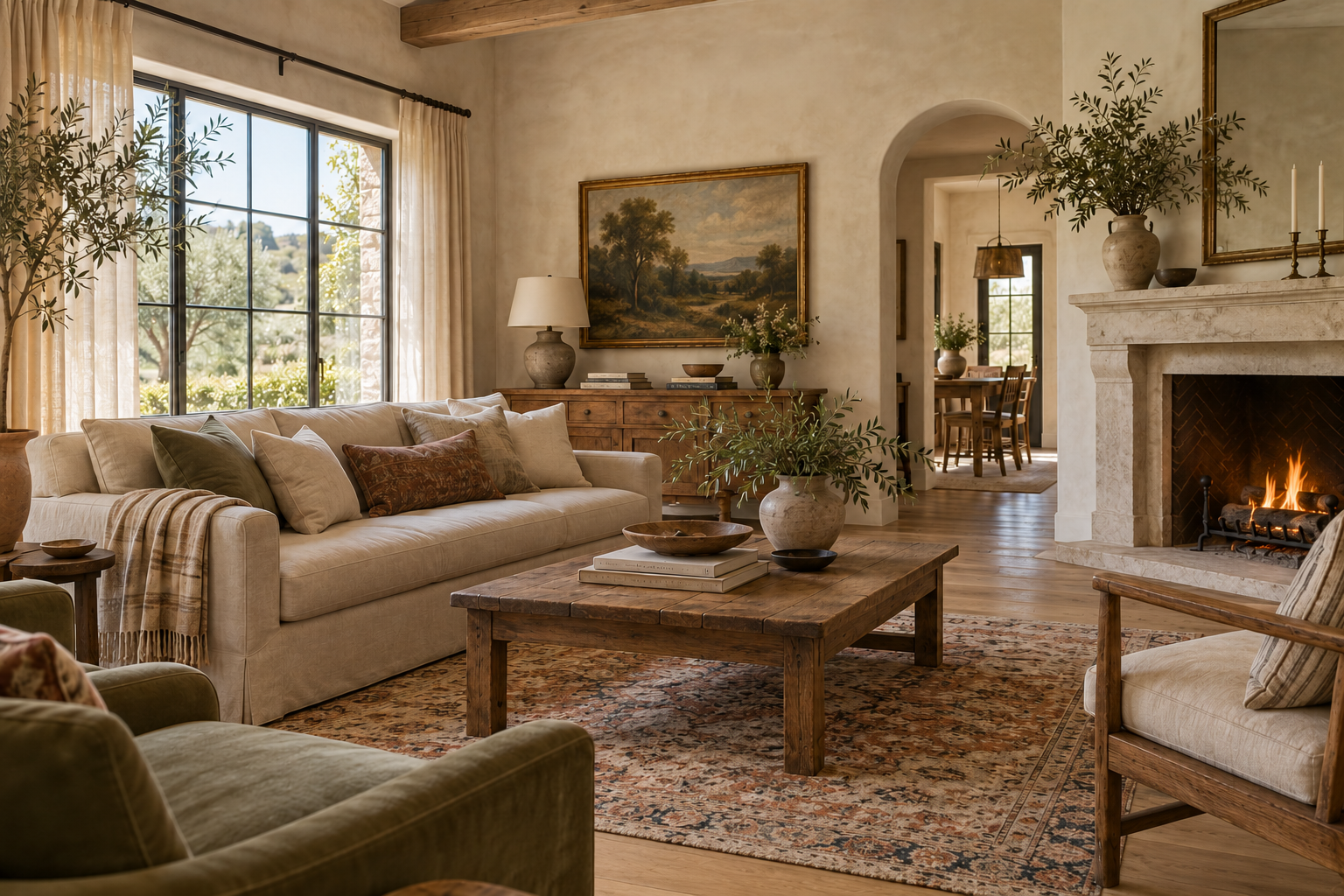
Farmhouse style has outlived more trend cycles than most of us can count. It has been polished, commercialized, stripped back, and reimagined—but at its best, it still feels less like a decorating theme and more like a sensible way to make a home.
The reason is simple: true farmhouse style is built around things that age well. Natural wood, useful furniture, washable linen, old art, generous curtains, sturdy rugs, and objects gathered slowly all become more convincing with time. None of them need a farmhouse-shaped label to explain what they are.
If you love the warmth of farmhouse interiors but want to avoid a room that feels overly themed, this is the version worth borrowing from: quiet, practical, layered, and a little imperfect.
Why farmhouse style still works
Farmhouse style works because its best ideas come from daily life rather than display. A substantial table can handle homework and dinner. Curtains soften a room while controlling light. A wide bowl catches keys or fruit. A worn rug makes muddy footprints less alarming. Even the decorative pieces—landscape paintings, pottery, branches—usually reference nature and the world just outside the window.
That usefulness gives the style staying power. It also makes farmhouse surprisingly easy to mix with other looks. Its warm materials work beside the clean silhouettes of organic modern rooms, while plaster, aged timber, and earthy ceramics overlap beautifully with Mediterranean interiors. We explore those similarities more closely in our guide to Organic Modern vs. Mediterranean style.
The goal is not to make every object look old. It is to make the room feel as though it could grow old gracefully.
1. Layer the windows instead of overdecorating them
One of the most effective farmhouse details is also one of the most practical: double-layer curtains. Install a double rod so a light, almost translucent panel can sit closest to the glass, with a heavier linen or linen-look curtain on the front rail.
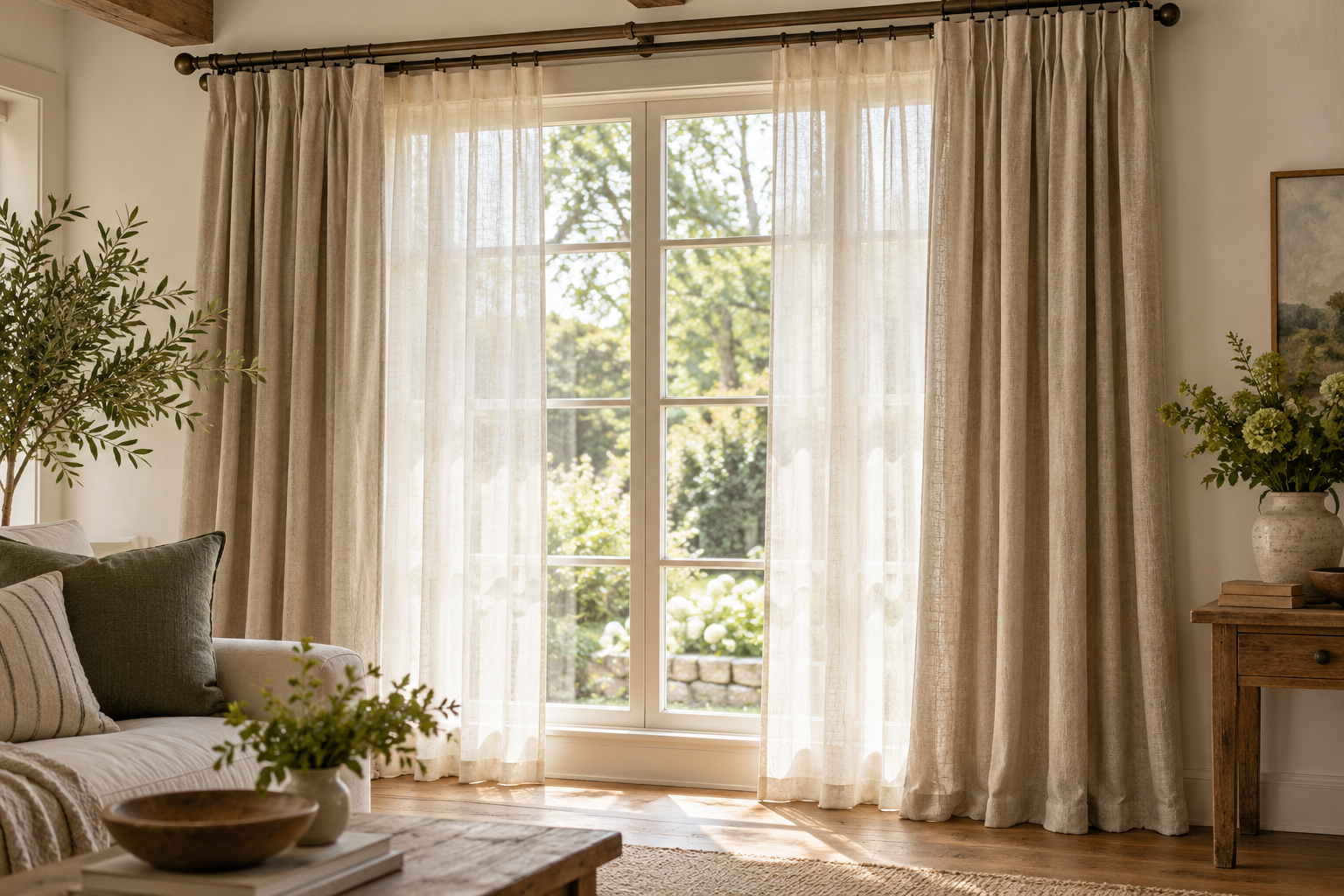
During the day, the sheer layer gives you privacy without flattening the natural light. At night, the thicker curtain makes the room feel sheltered and finished. The pairing also creates depth without asking for a bold print or elaborate trim.
- Mount the rod several inches above the window frame to make the opening feel taller.
- Extend it beyond both sides of the frame so the curtains can stack away from the glass.
- Aim for panels that reach the floor and look comfortably full, not stretched flat.
- Choose a warm white sheer rather than a bright optical white, especially beside cream walls.
The double rod is the small piece of hardware that makes the whole arrangement work. It lets each layer move independently, so the window can change with the light and with real life.
2. Let the furniture bring the history
An inherited table, a restored dresser, or a genuinely old cabinet will always bring more character than a complete matching furniture set. Those pieces carry marks that cannot be convincingly printed at a factory: softened edges, slight color variation, old joinery, and the evidence of being useful before they arrived in your room.
But antiques are not the only route. If you are buying new, look for classic proportions, simple construction, and wood that is allowed to look like wood. A plain rectangular dining table, a substantial square coffee table, or a cabinet with restrained hardware can sit comfortably in a farmhouse room without pretending to be a barn find.
Wood and simplicity usually win. Skip exaggerated distressing, decorative X-shapes on every surface, and sets that repeat the same finish around the entire room. One convincing wooden piece is stronger than five pieces working too hard to tell the same story.
3. Use the rug to decide how quiet—or expressive—the room feels
Jute rarely fails in a farmhouse interior. It is earthy, durable-looking, and relaxed enough to connect new furniture with older pieces. It is especially useful when the room already has plenty of pattern in pillows, curtains, or art.
Still, jute is not the only answer. A beautiful patterned rug can be even better when the furniture and walls are quiet. Look for a faded traditional pattern, soft contrast, and colors that feel slightly muted rather than newly saturated—warm rust, olive, tobacco, slate blue, or sand. Pattern hides everyday wear and gives a neutral room somewhere to come alive.
Whichever direction you choose, size matters more than style. In a living room, the rug should at least reach beneath the front legs of the main seating. A tiny rug floating under the coffee table will make even generous furniture feel disconnected.
4. Fill vessels with what is growing nearby
Farmhouse rooms need a little looseness, and branches provide it instantly. A wide ceramic vessel with olive branches, fresh eucalyptus, leafy garden cuttings, or a handful of dried stems gives height and movement without looking fussy.
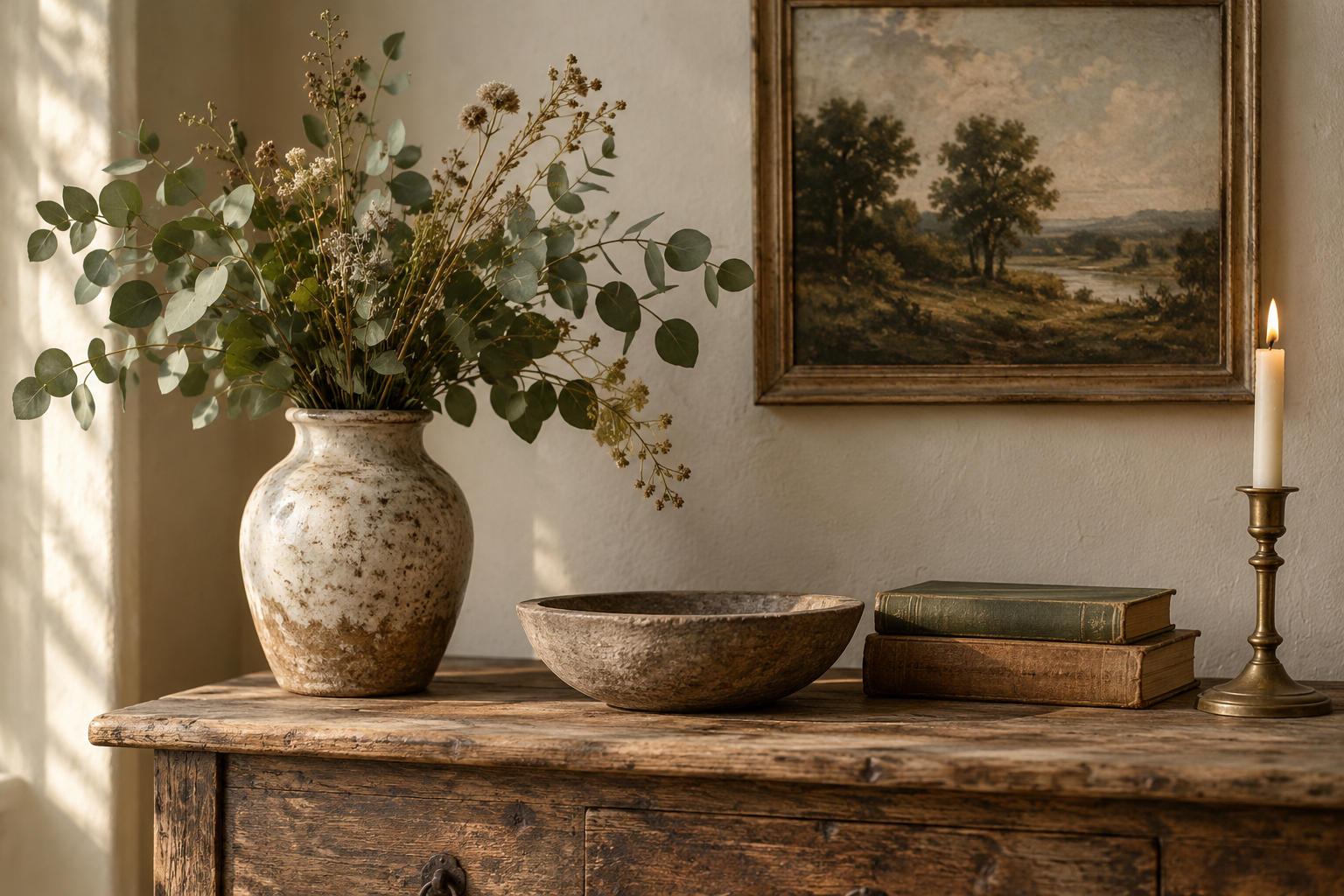
Yes, very convincing faux branches exist, and they are useful when fresh greenery is difficult to find. But before buying a permanent plastic bouquet, look outside. A few responsibly gathered branches or naturally dried seed heads often have better scale, variation, and personality—and they cost nothing. Gather only where it is permitted, avoid protected plants, and never take more than the landscape can spare.
The vessel does not have to be precious. An old crock, an earthenware pitcher, a simple green-glazed vase, or a stone-look pot can all work. What matters is that the opening is wide enough for the branches to spread naturally and the base is heavy enough to keep them stable.
5. Choose landscape art with matte, quiet color
Landscape art belongs naturally in farmhouse rooms because it extends the material story: fields, trees, water, changing skies, and colors drawn from the outdoors. Vintage pieces are wonderful, but a newer print can work just as well if the palette and finish feel restrained.
Look for matte greens, umber, cream, smoke blue, and soft charcoal, then allow one small note of warmer color to stand out. An aged gold, dark wood, or slim black frame gives the image definition without turning it into a formal centerpiece. If a room feels too beige, art is often the safest place to add depth.
Avoid filling every wall. One landscape with enough breathing room can do more than a gallery wall assembled simply because an empty surface felt unfinished. This is the same principle behind making a room feel collected rather than decorated: let each addition earn its place.
6. Add useful objects, not filler
The final layer should make the room easier to use. A wooden tray corrals remotes on a coffee table. A stone bowl catches keys by the door. A linen runner softens a dining table without hiding the grain. A ceramic lamp brings texture at eye level, while a pair of simple brass candleholders gives evening light a place to land.
These pieces can be beautiful, but they should not exist only to occupy a surface. Start with what the room needs, then choose the most tactile, long-lasting version you can reasonably find. Our guide to home accessories that elevate a room uses the same approach.
The difference between timeless farmhouse and themed farmhouse
| Choose more of this | And less of this |
|---|---|
| Real or convincingly simple wood | Heavy artificial distressing |
| Linen, cotton, wool, and jute | Matching fabric sets |
| Old furniture mixed with quiet new pieces | A full room purchased as one collection |
| One landscape or meaningful artwork | Word signs explaining how the room should feel |
| Fresh or naturally dried branches | Multiple identical faux arrangements |
| Warm neutrals with muted color | All white without texture or contrast |
| Objects that are useful or personal | Decor bought only to fill empty space |
A simple farmhouse formula for any room
You do not need to renovate an entire house to bring in the feeling. Begin with five moves:
- Choose one honest material. Let wood, linen, plaster, stone, or woven fiber set the direction.
- Add one piece with age. It can be inherited, thrifted, restored, or simply something you have owned long enough to love.
- Soften the light. Use a fabric shade, layered curtains, candles, or a warm table lamp instead of relying only on overhead lighting.
- Bring in something living. Try a branch, herb pot, bowl of seasonal fruit, or flowers from the yard.
- Leave some space unfinished. A home can feel cared for before every wall and tabletop is full.
If you are changing the walls themselves, the soft movement of limewash or plaster can support this look beautifully; our comparison of limewash, Venetian plaster, and paint explains the practical differences.
The real reason farmhouse feels timeless
Farmhouse style is timeless when it stops trying to prove that it is farmhouse. Its strongest elements—useful furniture, natural texture, soft light, sturdy textiles, old art, and branches gathered close to home—would still make sense if the trend disappeared tomorrow.
Build the room slowly. Keep the pieces that tell a story. Choose new things for their material and function, not because they belong to a labeled collection. The result will feel warm, grounded, and personal—and that is why this style continues to work so well.
If you would like a visual starting point, we gathered a few examples of the materials and shapes discussed here in our Farmhouse Essentials Idea List. Use it as inspiration, then check what you already own, what can be restored, and what you might find locally first.
Disclosure: This page includes an affiliate link. As an Amazon Associate I earn from qualifying purchases, at no additional cost to you. We only link the collection as an optional source of inspiration; the advice in this article is not dependent on purchasing any specific product.